


Journey to the West 西遊記


Journey to the West is a Chinese novel published in the 16th century during the Ming dynasty and attributed to Wu Cheng'en. It is regarded as one of the great Chinese novels, and has been described as arguably the most popular literary work in East Asia. It was widely known in English-speaking countries through the British scholar Arthur Waley's 1942 abridged translation Monkey.

The novel is a fictionalized and fantastic account of the pilgrimage of the Chinese Buddhist monk Xuanzang, who went on a 19-year journey to India in the 7th century AD to seek out and collect Buddhist scriptures (sūtras). The novel retains the broad outline of Xuanzang's own account, Records of the Western Regions, but embellishes it with fantasy elements from folk tales and the author's invention. The beginning part of the story deals with the earlier exploits of Sun Wukong, a monkey born on Flower Fruit Mountain from a stone egg that forms from an ancient rock created by the coupling of Heaven and Earth, who learns the art of the Tao, 72 polymorphic transformations, combat, and secrets of immortality, and whose guile and force earns him the name Qitian Dasheng (齐天大圣; 齊天大聖; 'Great Sage Equal to Heaven'). Wukong was tasked by Bodhisattva Guanyin and the Buddha to become Tang Sanzang's first disciple, journeying with him to India and provides him with three other disciples who agree to help him in order to atone for their sins: Zhu Bajie, Sha Wujing and White Dragon Horse. Riding the latter, Sanzang and his disciples journey to a mythical version of India and find enlightenment through the power and virtue of cooperation.
Journey to the West has strong roots in Chinese folk religion, Chinese mythology, Chinese Buddhism, Confucianism, Taoist and Buddhist folklore. The pantheon of Taoist immortals and Buddhist bodhisattvas are still reflective of certain Chinese religious attitudes today, while being the inspiration of many modern anime series. It contains many religious references and spiritual concepts which often involve plays on Chinese names of characters and places, which are often lost in translation to other languages. It is a progenitor to the xianxia literary genre that combines martial arts with high fantasy. Enduringly popular, the novel is simultaneously a comic adventure, a satire of Chinese bureaucracy, a source of spiritual reflection, and a rich allegory.


Although Journey to the West is a work of fantasy, it is based on the actual journey of the Chinese monk Xuanzang (602–664), who traveled to India in the 7th century in order to seek out Buddhist scriptures and bring them back to China. Xuanzang was a monk at Jingtu Temple in the imperial capital Chang'an (present-day Xi'an) during the late Sui dynasty and early Tang dynasty. He left Chang'an in 629, in defiance of Emperor Taizong of Tang's ban on travel. Helped by sympathetic Buddhists, Xuanzang traveled via Gansu and Qinghai to Kumul (Hami), thence following the Tian Shan mountains to Turpan. He then crossed regions that are today Kyrgyzstan, Uzbekistan and Afghanistan, into Gandhara, in what is today northern Pakistan, in 630. Xuanzang traveled throughout India for the next thirteen years, visiting important Buddhist pilgrimage sites, studying at the ancient university at Nalanda, and debating the rivals of Buddhism.
Xuanzang left India in 643 and arrived back in Chang'an in 646. Although he had defied the imperial travel ban when he left, Xuanzang received a warm welcome from Emperor Taizong upon his return. The emperor provided money and support for Xuanzang's projects. He joined Da Ci'en Monastery (Monastery of Great Maternal Grace), where he led the building of the Big Wild Goose Pagoda to store the scriptures and icons he had brought back from India. He recorded his journey in the book Great Tang Records on the Western Regions. With the support of the emperor, he established an institute at Yuhua Gong (玉华宫; 玉華宮; Yùhuá Gōng; "Palace of the Luster of Jade") monastery dedicated to translating the scriptures he had brought back. His translation and commentary work established him as the founder of the Faxiang tradition of Buddhism. Xuanzang died on 7 March, 664. The Xingjiao Monastery was established in 669 to house his ashes.

The monk Tang Sanzang (唐三藏; Táng Sānzàng, meaning "Tripitaka Master of Tang," with Tang referring to the Tang dynasty and Sanzang referring to the Tripiṭaka, the main categories of texts in the Buddhist canon which is also used as an honorific for some Buddhist monks) is a Buddhist monk who had renounced his family to become a monk from childhood. He is just called "Tripitaka" in many English versions of the story. He set off for the Tianzhu Kingdom (天竺国; 天竺國; Tiānzhú Guó), an appellation for India in ancient China, to retrieve original Buddhist scriptures for China. Although he is helpless in defending himself, the bodhisattva Guanyin helps by finding him powerful disciples who aid and protect him on his journey. In return, the disciples will receive enlightenment and forgiveness for their sins once the journey is done. Along the way, they help the local inhabitants by defeating various monsters and demons who try to obtain immortality by consuming Tang Sanzang's flesh.
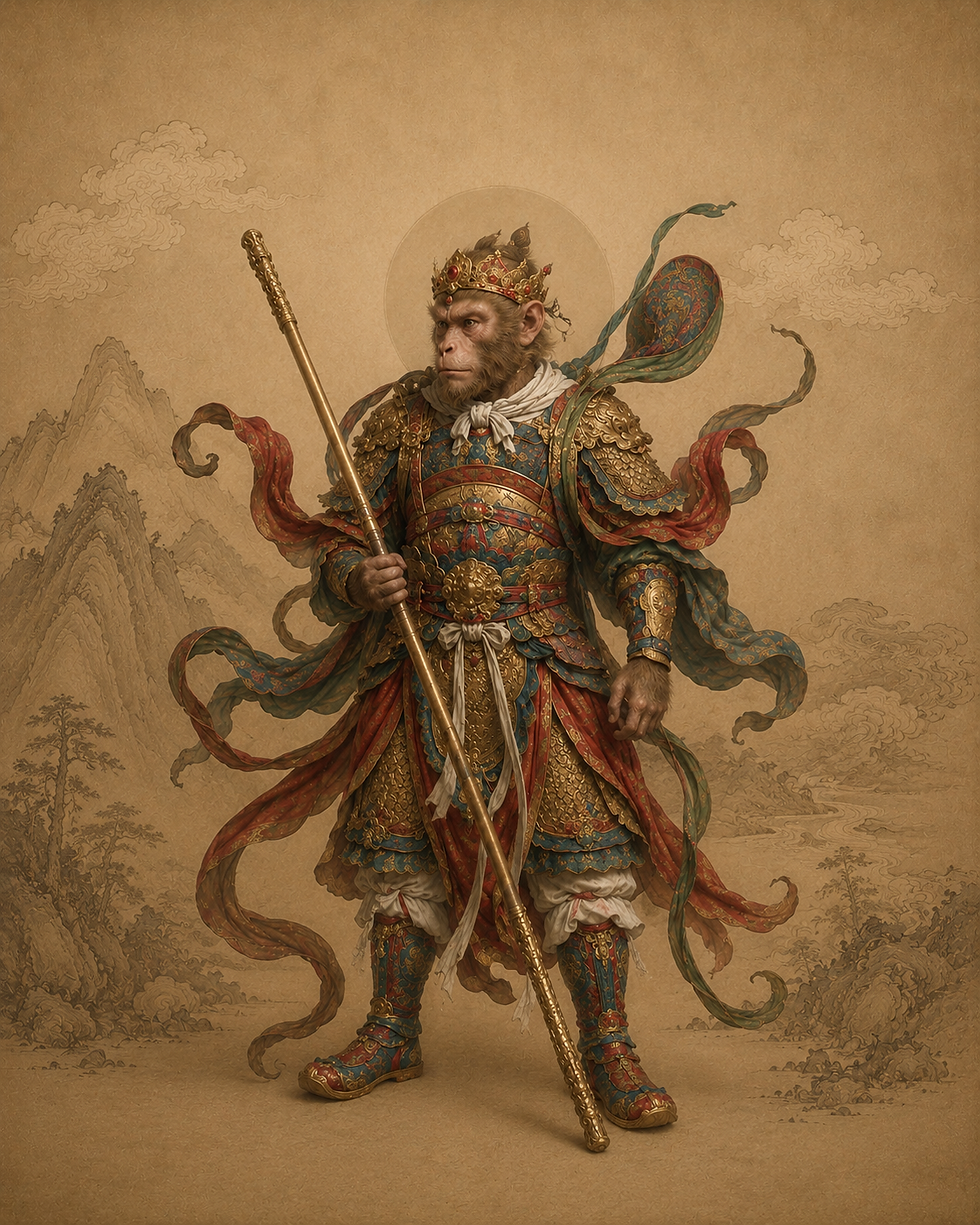
Sun Wukong (孙悟空; 孫悟空; Sūn Wùkōng) is the name given to this character by his teacher, Subhuti, the latter part of which means "Awakened to Emptiness" (in the Waley translation, Aware-of-Vacuity); he is often called the "Monkey King". He is born on Flower Fruit Mountain from a stone egg that forms from an ancient rock created by the coupling of Heaven and Earth. He first distinguishes himself by bravely entering the Water Curtain Cave on the mountain; for this feat, his monkey tribe gives him the title of "Handsome Monkey King" (美猴王; měi hóuwáng). After seeing a fellow monkey die because of old age, he decides to travel around the world to seek the Tao and find a way to be able to live forever. He eventually found the Grand Master of Bodhi (菩提祖师; 菩提祖師; pútí zǔshī), who taught him the 72 earthly transformations and a "somersault cloud", which allows him to travel 108,000 li almost instantaneously. After angering several gods and coming to the attention of the Jade Emperor, he is given a minor position in heaven as the Keeper of Horses (弼马温; 弼馬溫; bìmǎwēn) so they can keep an eye on him. When Sun realizes that he was given the lowest position in heaven and is not considered a full-fledged god, he becomes very angry. Upon returning to his mountain, he puts up a flag and declares himself the "Great Sage Equal to Heaven" (齐天大圣; 齊天大聖; Qítiān Dàshèng). The Jade Emperor dispatches celestial soldiers to arrest Sun Wukong, but none succeed. The Jade Emperor has no choice but to appoint him to be the guardian of the Peach Garden of Immortality. The different varieties of peach trees in the garden bear fruit every 3,000, 6,000, and 9,000 years, and eating their flesh will bestow immortality and other gifts, so Sun Wukong eats nearly all of the ripe peaches. Later, after fairies who come to collect peaches for Xi Wangmu's heavenly peach banquet inform Sun Wukong he is not invited and make fun of him, he once again begins to cause trouble in Heaven, stealing heavenly wine from the peach banquet and eating Laozi's pills of immortality. He defeats an army of 100,000 celestial troops, led by the Four Heavenly Kings, Erlang Shen, and Nezha. Eventually, the Jade Emperor appeals to the Buddha, who seals Wukong under a mountain called Five Elements Mountain after the latter loses a bet regarding whether he can leap out of the Buddha's hand in a single somersault. Sun Wukong is kept under the mountain for 500 years and cannot escape because of a seal that was placed on the mountain. He is later set free when Tang Sanzang comes upon him during his pilgrimage and accepts him as a disciple.
His primary weapon is his staff, the Ruyi Jingu Bang, which he can shrink down to the size of a needle and keep in his ear, as well as expand it to gigantic proportions. The rod, which weighs 17,550 pounds (7,960 kg), was originally a pillar supporting the undersea palace of the Dragon King of the East Sea, but he was able to pull it out of its support and can swing it with ease. The Dragon King had told Sun Wukong he could have the staff if he could lift it, but was angry when the monkey was actually able to pull it out and accused him of being a thief. Sun Wukong was insulted, so he demanded a suit of armor and refused to leave until he received one. The Dragon King of the East and the other dragon kings, fearful of Sun wreaking havoc in their domain, gave him a suit of golden armor. These gifts, combined with his devouring of the peaches of immortality, erasing his name from the Book of the Dead, drinking heavenly wine from the Peach Festival, eating Laozi's pills of immortality, and being tempered in Laozi's Eight-Trigram Furnace (after which he gained a steel-hard body and fiery golden eyes that could see far into the distance and through any disguise), makes Sun Wukong by far the strongest member of the pilgrimage. Besides these abilities, he can also pluck hairs from his body and blow on them to convert them into whatever he wishes (usually clones of himself to gain a numerical advantage in battle). Furthermore, he is a master of the 72 transformations (七十二变; 七十二變; qīshíèr biàn), and can transform into anything that exists (animate and inanimate). Notably, however, Sun cannot fight as well underwater, and often the pilgrimage must rely on Pigsy and Sandy for marine combat. The monkey, nimble and quick-witted, uses these skills to defeat all but the most powerful of demons on the journey.
Sun's behavior is checked by a band placed around his head by Guanyin, which cannot be removed by Sun Wukong himself until the journey's end. Tang Sanzang can tighten this band by chanting the "Ring Tightening Mantra" (taught to him by Guanyin) whenever he needs to chastise him. The spell is referred to by Tang Sanzang's disciples as the "Headache Sutra". Tang Sanzang speaks this mantra quickly in repetition when Sun disobeys him.
Sun Wukong's childlike playfulness and often goofy impulsiveness is in contrast to his cunning mind. This, coupled with his great power, makes him a trickster hero. His antics present a lighter side in the long and dangerous trip into the unknown.
After completion of the journey, Sun is granted the title of Victorious Fighting Buddha (斗战胜佛; 鬥戰勝佛; dòu zhànshèng fó) and ascends to Buddhahood.

Zhu Bajie (猪八戒; 豬八戒; Zhū Bājiè, literally "Pig of the Eight Prohibitions") is also known as Zhu Wuneng (猪悟能; 豬悟能; Zhū Wùnéng; 'Pig Awakened to Power'), and given the name "Monk Pig", "Piggy", "Pigsy", or just simply "Pig" in English.
Once an immortal who was the Marshal of the Heavenly Canopy commanding 100,000 naval soldiers of the Milky Way, he drank too much during a celebration of the gods and attempted to harass the moon goddess Chang'e, resulting in his banishment to the mortal world. He was supposed to be reborn as a human but ended up in the womb of a sow due to an error on the Reincarnation Wheel, which turned him into a half-man, half-pig humanoid monster. Zhu Bajie was very greedy, and could not survive without eating ravenously. Staying within the Yunzhan Dong ("cloud-pathway cave"), he was commissioned by Guanyin to accompany Tang Sanzang to India and given the new name Zhu Wuneng.
However, Zhu Bajie's lust for women led him to the Gao Family Village, where he posed as a handsome young man and helped defeat a group of robbers who tried to abduct a maiden. Eventually, the family agreed to let Zhu Bajie marry the maiden. But during the day of the wedding, he drank too much alcohol and accidentally returned to his original form. Being extremely shocked, the villagers ran away, but Zhu Bajie wanted to keep his bride, so he told the bride's father that if after one month the family still did not agree to let him keep the bride, he would take her by force. He also locked the bride up in a separate building. At this point, Tang Sanzang and Sun Wukong arrived at the Gao Family Village and helped defeat him. Renamed Zhu Bajie by Tang Sanzang, he consequently joined the pilgrimage to the West.
His weapon of choice is the jiuchidingpa (九齿钉耙; 九齒釘耙; jiǔchǐdīngpá; "nine-tooth iron rake"). He is also capable of 36 transformations and can travel on clouds, but not as fast as Sun Wukong. However, Zhu is noted for his fighting skills in the water, which he used to combat Sha Wujing, who later joined them on the journey. He is the second strongest member of the team.
Pigsy's lust for women, extreme laziness, and greediness, made his spirituality the lowest in the group, with even the White Dragon Horse achieving more than him, and he remained on Earth and was granted the title "Cleaner of the Altars," with the duty of cleaning every altar at every Buddhist temple for eternity by eating excess offerings.

Sha Wujing (沙悟净; 沙悟淨; Shā Wùjìng, "Sand Awakened to Purity"), given the name "Friar Sand", "Sand Monk", "Sandman", "Sand Fairy", "Sand Orc", "Sand Ogre", "Sand Troll", "Sand Oni", "Sand Demon", "Sand Monster", "Sand Hulk", "Sand", or "Sandy" in English, was once a celestial Curtain Lifting General, who stood in attendance by the imperial chariot in the Hall of Miraculous Mist. He was exiled to the mortal world and made to look like a sandman, orc, ogre, troll, oni, demon, monster, or hulk because he accidentally smashed a crystal goblet belonging to the Queen Mother of the West during a Peach Banquet. The now-hideous immortal took up residence in the Flowing Sands River, terrorizing surrounding villages and travelers trying to cross the river. However, he was subdued by Sun Wukong and Zhu Bajie when Tang Sanzang's party came across him. They consequently took him in, as part of the pilgrimage to the West.
Sha Wujing's weapon is a magic wooden staff wrapped in pearly threads, although artwork and adaptations depict him with a Monk's spade staff. He also knows 18 transformation methods and is highly effective in water combat. He is the most obedient, logical, and polite of the three disciples, and always takes care of his master, seldom engaging in the bickering of his fellow disciples. Because he has no major faults or extraordinary characteristics, he is sometimes seen as a minor character, but he is the peacekeeper of the group, mediating between Wukong, Bajie, and even Tang Sanzang and others. He is also the person whom Tang Sanzang consults when faced with difficult decisions.
He eventually becomes an arhat at the end of the journey, giving him a higher level of exaltation than Zhu Bajie, who is relegated to cleaning altars, but lower spiritually than Sun Wukong and Tang Sanzang, who are granted Buddhahood.

The White Dragon Horse (白龍馬) is the third son of Ao Run, the Dragon King of the West Sea. He was originally supposed to be executed for accidentally destroying a pearl gifted by the Jade Emperor, but Guanyin saved him and brought him to Yingchou Stream (鷹愁澗) in Shepan Mountain (蛇盤山). When Tang Sanzang and Sun Wukong pass by the stream, the Dragon devours Tang Sanzang's horse and retreats after realising he is no match for Sun Wukong. Later, the Dragon transforms into the White Dragon Horse to serve as Tang Sanzang's steed for the rest of his journey.

Avalokiteśvara Bodhisattva (觀世音菩薩), better known as Guanyin Bodhisattva (觀音菩薩) or simply Guanyin (觀音) in the novel, is based on Mount Potalaka. During their quest, the protagonists seek help from Guanyin from time to time to deal with yaoguai that they cannot overcome, such as Great King of Numinous Power and Sai Tai Sui.

Red Boy (紅孩兒), also known as Divine Infant Great King (圣婴大王), is a yaoguai who is Bull Demon King and Princess Iron Fan's son. A formidable opponent to Sun Wukong, he is capable of breathing samadhi fire, which drives back Sun Wukong. After Sun Wukong seeks help from Guanyin, Red Boy later finds Guanyin's lotus throne by chance and disrespectfully sits on it, but ends up being trapped and subdued. Red Boy eventually agrees to give up his evil ways and serve as an attendant to the bodhisattva.

Princess Iron Fan (鐵扇公主) is a rakshasa who is Bull Demon King's estranged wife and Red Boy's mother. Her secret weapon is a banana leaf fan, which can create strong winds. When Sun Wukong tries to borrow her fan to put out the fires at the Flaming Mountains, she is extremely hostile towards him because of his role in her son's downfall. Sun Wukong then uses trickery to steal the fan from her.

The White Bone Demoness (白骨精), sometimes translated as Lady White Bone, is a shapeshifting skeleton yaoguai. She disguises herself as a young woman, pretending to offer poisoned fruits to Tang Sanzang. Sun Wukong sees through her ruse and apparently kills the young woman, but the yaoguai escapes and returns later in disguise as the young woman's mother. Sun Wukong sees through her disguise again and apparently kills the older woman. The yaoguai flees yet again and returns in disguise as a man claiming to be the older woman's husband and younger woman's father. Sun Wukong sees through the yaoguai's third disguise and finally destroys her. However, Tang Sanzang has been misled into believing that Sun Wukong has just murdered three innocent people, so he banishes Sun Wukong after the third time.
This AI-assisted cosplay photography series is a contemporary visual homage to Journey to the West (《西游记》), one of the Four Great Classical Novels of Chinese literature. Rather than reproducing familiar cinematic interpretations, the project reimagines the novel’s beloved heroes, immortals, demons, and deities as highly photorealistic, painterly portraits that bridge classical Chinese art with modern digital image creation.
Inspired by the elegance of traditional ink-and-scroll paintings, each portrait is rendered in a warm, muted palette of antique golds, soft earth tones, and delicate atmospheric lighting. The compositions evoke the timeless beauty of classical Chinese landscape painting while presenting each character as though they existed in the real world, captured through the lens of a master portrait photographer.
The collection features many of the novel’s iconic personalities, including the fearless Sun Wukong, the Monkey King, whose celestial armour and commanding stance embody both his rebellious spirit and divine authority; the loyal but gluttonous Zhu Bajie (Pigsy), portrayed with surprising dignity and humanity; the steadfast Sha Wujing (Sandy), whose weathered appearance reflects years of hardship and unwavering devotion; and the compassionate Tang Sanzang, the monk whose wisdom and faith guide the pilgrimage toward enlightenment.
Alongside the pilgrims are several memorable supernatural figures. The graceful Princess Iron Fan appears as a refined immortal warrior, her legendary fan transformed into an elegant symbol of both beauty and formidable power. The haunting White Bone Demoness (Bai Gu Jing) is depicted with ethereal poise, balancing delicate femininity with an unmistakable aura of supernatural menace. Their contrasting personalities enrich the visual narrative, illustrating the moral complexity and mythical imagination that have made Journey to the West an enduring masterpiece.
The project also celebrates the divine realm that surrounds the pilgrimage, portraying celestial beings and bodhisattvas with an emphasis on serenity, compassion, and transcendence. Flowing robes, intricate embroidery, luminous halos, and carefully crafted historical costume details reinforce the spiritual atmosphere while remaining faithful to the artistic traditions that inspired the original illustrations.
Rather than emphasizing spectacle alone, this series seeks to humanize legendary figures while preserving their mythological grandeur. Every costume, prop, facial expression, and environmental detail has been thoughtfully designed to create believable, cinematic portraits that feel simultaneously ancient and contemporary. The result is a visual interpretation that respects centuries of Chinese artistic heritage while demonstrating how AI-assisted creative workflows can breathe new life into timeless stories.
Ultimately, this collection is both a tribute to one of China’s greatest literary achievements and an exploration of how traditional mythology can be reimagined through modern digital artistry. It invites viewers to rediscover the enduring themes of courage, redemption, loyalty, temptation, and enlightenment that continue to make Journey to the West one of the world’s most beloved epic adventures.


Comments