


Court Ladies Wearing Flowered Headdresses 簪花仕女圖



Zhou Fang (周昉 c. 730–800), courtesy name Zhonglang (仲朗), was a Chinese painter during the Tang dynasty. He lived in the Tang capital of Chang'an (modern Xi'an) and painted for the emperor. Zhou Fang came from a wealthy and prominent family, so he was very familiar with the luxurious life of the aristocratic class. He successively served as the governor of Yuezhou and Xuanzhou.
Zhou Fang was very skilled in writing, in drawing figures such as Buddha statues, and especially in depicting aristocratic women. He had a dignified appearance, a plump physique, and soft and majestic colors, which were favored by the court officials at that time. He was an important figure painter who emerged after Wu Daozi, a famous religious and figure painter, during the middle Tang dynasty. He imitated Zhang Xuan in early years, but later changed and created a unique style. The most famous Buddhist image created by Zhou Fang is "Water Moon Guanyin" which became a popular standard called "Zhou Jiaxiang". Both Zhou Fang and Zhang Xuan broke out of the circle of religious painting and developed towards genre painting.
Zhou Fang's Buddhist paintings have long been a popular standard, known as the "Zhou family style". Standing side by side with the "Cao family style", "Zhang family style", and "Wu family style", collectively known as the "Four Family Styles", the "Zhou family style" is the earliest style in ancient China with the characteristics of a painting school and is highly praised by painters throughout history.
Heirloom works of Zhou include the "Court Ladies Wearing Flowered Headdresses" scroll, the "A painting of a lady waving a fan" scroll, and the "Tuning the qin and sipping tea" scroll.
The characteristics of Zhou Fang's works, according to records at that time, were "simple and powerful clothing" and "soft and beautiful colors". The portrayal of women is characterized by their richness, which can be seen in the existing works of Zhou Fang, such as "A painting of a lady waving a fan" and "Court Ladies Wearing Flowered Headdresses". Zhou Fang's artistic career was long, three to four decades, running parallel to the Dàlì to Zhenyuan era (766–805). His artistic activity was mainly concentrated in Chang'an and Jiangnan.
Zhou Fang's fame spread abroad. In the late Zhenyuan period, envoys and merchants from the Silla Kingdom (on the present-day Korean Peninsula) in the Tang dynasty purchased dozens of works of his at high prices and transported them back to their own country. The Japanese also liked Zhou Fang's style of painting of beautiful women, showing his influence on painting in the East.
Zhou Fang's works were very popular among Koreans during the Tang dynasty. Today, Japan retains ancient paintings of beautiful women in the style of Zhou Fang. The image of women with plump faces was widely popular in China itself, especially during the middle Tang dynasty and afterwards.
The themes of his artwork included religious subjects and everyday life.


Zhou created paintings of goddesses modeled after imperial court ladies, a development that indicated religious painting was to become more realistic, and that secular painting was beginning to take on its initial form. His portrait paintings emphasized real life, and, as forerunners of secular lady paintings, they influenced later paintings of court ladies. More than half of Zhou Fang's works were paintings of beautiful women. They mainly focused on the enjoyment of life among the noble concubines in the upper class society at that time, such as tea making, palace riding, spring outings, playing the flute, and playing games. Zhou Fang's works depicting Tang Xuanzong and Yang Guifei indulging in leisure include "The Night Tour of Emperor Ming", "The Bathing Lady", "The Fighting Cock and Shooting Birds of Emperor Ming".

"The Picture Scroll of Lady with Hairpin Flowers" draws inspiration from the life of palace women, with gorgeous and luxurious concubines leisurely strolling in the garden. The characters have a plump physique, calm and leisurely movements, and peaceful expressions. The identities and lifestyle characteristics of the concubines are well expressed. The painting is currently housed in the Liaoning Provincial Museum.

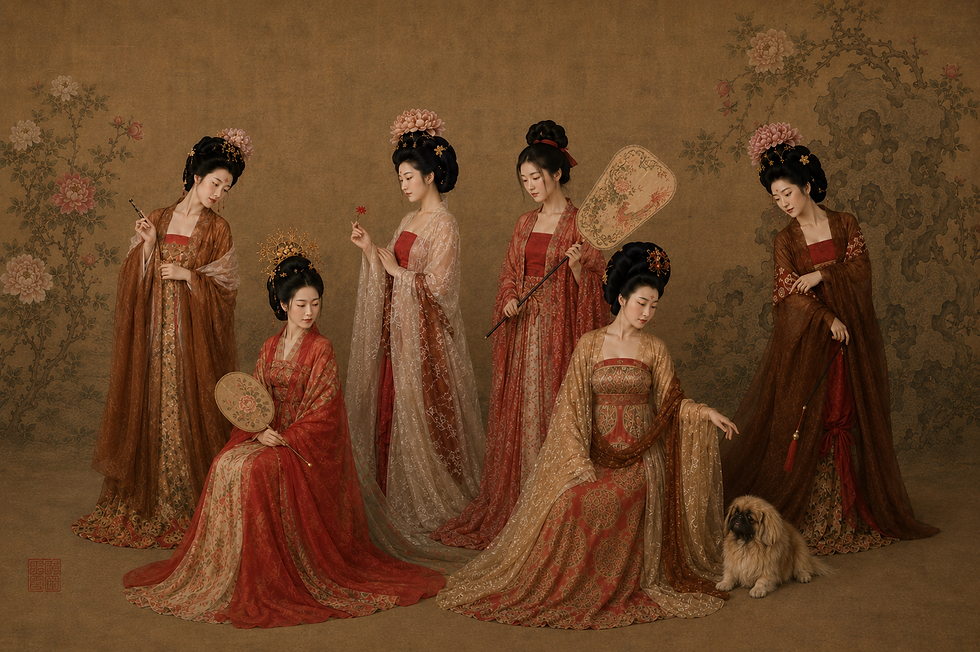
This AI-assisted fanart cosplay photography project pays homage to one of the most celebrated masterpieces of the Tang dynasty: Zhou Fang’s Court Ladies Adorning Their Hair with Flowers (簪花仕女圖). Rather than attempting a literal recreation, the series reinterprets the spirit of the iconic scroll through contemporary photographic portraiture enhanced with artificial intelligence, creating a visual dialogue between one of China’s greatest classical paintings and modern digital artistry.
The six ladies are arranged in an elegant, scroll-like composition that echoes the graceful rhythm of Zhou Fang’s original work. Each figure possesses her own distinctive personality and gesture—some quietly admiring a blossom, others holding ornate fans or delicate accessories, while another is accompanied by a small Pekingese dog, a subtle reference to the aristocratic lifestyle depicted in Tang court paintings. Their varied poses create a gentle visual flow across the composition, inviting the viewer’s eye to wander naturally from one court lady to the next, much like the experience of viewing an ancient handscroll.
Great care was taken to preserve the defining characteristics of Tang dynasty aesthetics. The sumptuous silk robes feature layered translucent fabrics, intricate woven motifs, and harmonious shades of crimson, gold, ivory, and warm earth tones. Towering coiffures decorated with fresh blossoms and delicate gold ornaments celebrate the refined beauty standards of the High Tang period, while soft expressions and restrained movements embody the elegance and quiet confidence associated with imperial court ladies.
The project embraces the painterly quality of traditional Chinese art while presenting the figures with a subtle degree of realism. Warm studio lighting, muted backgrounds, and restrained colour grading create the illusion that the women have gently stepped out from an ancient silk painting without sacrificing the timeless atmosphere of the original masterpiece. AI-assisted enhancements were employed not to replace artistic direction, but to refine costume textures, improve historical ambience, harmonize composition, and strengthen the illusion of classical brushwork translated into photographic form.
More than a historical recreation, this series celebrates the enduring influence of Zhou Fang’s artistic legacy. It demonstrates how classical Chinese painting can continue to inspire contemporary creators, allowing ancient ideals of beauty, grace, and refinement to be appreciated through modern visual storytelling. By combining traditional costume design, cosplay photography, digital artistry, and AI-assisted image generation, the project bridges more than twelve centuries of artistic history, inviting audiences to rediscover one of China’s greatest cultural treasures through a fresh and imaginative contemporary lens.


Comments