


Empress Wu 武則天


Empress Zetian (17 February 624– 16 December 705), personal name Wu Zhao, was the only undisputed female sovereign in the history of China. She had previously held power as the empress consort of Emperor Gaozong of the Tang dynasty from 660 to 683 and as empress dowager during the reigns of her sons, Emperors Zhongzong and Ruizong, between 683 and 690. She was the sole ruler of the self-styled Zhou dynasty from 690 to 705.
In her early life, Wu served as a concubine of Emperor Taizong. After his death, she married his successor, Emperor Gaozong, becoming empress in 655. Wu exercised substantial political influence even before her elevation and gradually came to dominate court affairs. After Gaozong suffered a debilitating stroke in 660, she effectively administered the empire on his behalf until his death in 683. Breaking with precedent, Wu then consolidated power and prevented her sons from ruling. In 690, she proclaimed the Zhou dynasty in place of the Tang and crowned herself emperor.
During her 45-year de facto rule over China, Wu institutionalized the use of informants and enforced stringent legal measures, purged members of the Tang royal house and veteran officials from earlier administrations, reformed the civil service system to promote merit, patronized Buddhism as well as literature and the arts, and conducted military campaigns against Turkic and Tibetan incursions. Her rule formed part of the High Tang period, a historic peak in China’s political power and cultural influence. In her later years, her governance became increasingly autocratic and extravagant. She was removed from power in the Shenlong Coup, which abolished the Zhou dynasty and restored the Tang, and she died a few months later.

No surviving, verified contemporary portraits of Wu Zetian exist. The most famous painting of China's only female emperor was an 8th-century silk masterpiece attributed to Tang dynasty court artist Zhang Xuan. This iconic artwork portrays her as a "plump, regal beauty" and is widely considered the most historically reliable representation. However, no authentic life portrait of Empress Wu is known to survive. Most familiar images of her were painted centuries after her death based on historical convention.
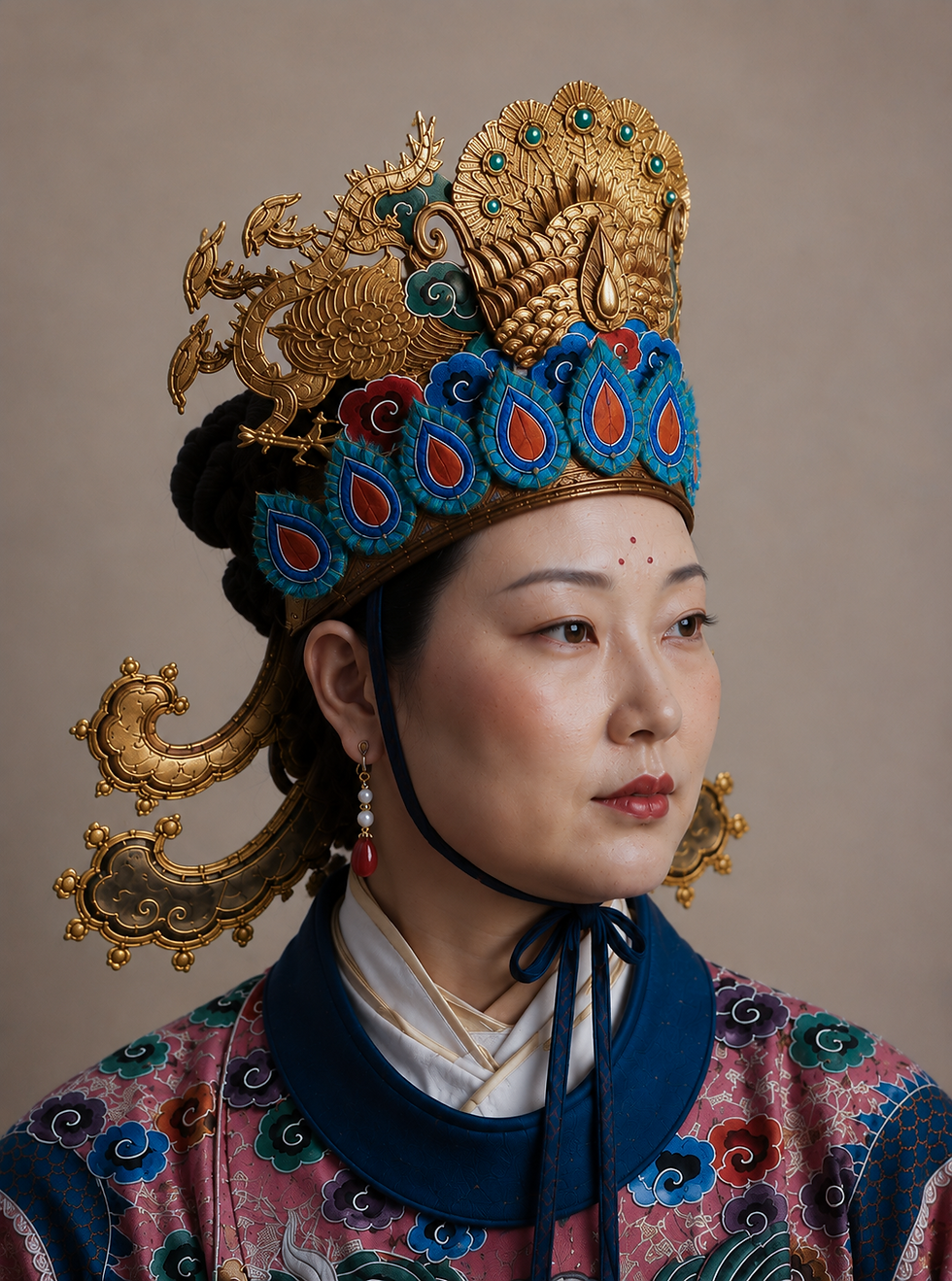


The AI assisted photo project is based on a commonly seen later traditional Chinese portrait created during the Qing Dynasty (1644-1912).
The project reimagines Empress Wu Zetian (武則天)—China’s only woman to reign in her own right as emperor. Rather than presenting a theatrical fantasy, the portrait seeks to evoke the restrained majesty and quiet authority characteristic of Tang court portraiture, while interpreting it through the language of contemporary fine art photography.
The elaborate phoenix crown serves as the visual centerpiece of the composition. Crafted to resemble finely worked imperial gold and adorned with brilliant blue kingfisher-feather-inspired ornamentation, it pays homage to the extraordinary craftsmanship of Tang ceremonial regalia. Every gilded flourish, engraved feather, and jeweled motif reflects the prestige of an empire at the height of its cultural and artistic influence.
The costume draws inspiration from surviving Tang court textiles, with richly embroidered cloud motifs, floral medallions, and auspicious dragons woven across luxurious silk. The harmonious palette of imperial gold, sapphire blue, jade green, and crimson echoes the vibrant pigments that once illuminated Tang paintings while maintaining a refined elegance befitting an imperial sovereign.
Rather than depicting Wu Zetian with overt displays of power, the portrait emphasizes her composure. Her calm expression, measured gaze, and dignified posture suggest the confidence of a ruler whose authority requires no dramatic gesture. Soft, museum-style lighting recalls the gentle tonal transitions of aged silk paintings, while subtle photographic realism breathes life into what might otherwise remain a distant historical image.
This project embraces AI not as a replacement for traditional artistry but as a creative collaborator, allowing ancient aesthetics to be translated into a convincing photographic vision. It explores the fascinating intersection of historical research, digital craftsmanship, costume design, and portrait photography, demonstrating how emerging technologies can help reinterpret classical Chinese art for modern audiences.
Ultimately, this tribute celebrates not only the remarkable legacy of Empress Wu Zetian, but also the enduring sophistication of Tang dynasty visual culture. By transforming the spirit of an ancient silk painting into a contemporary cosplay portrait, the work invites viewers to experience one of China’s most influential historical figures through a fresh yet deeply respectful artistic lens.


Comments