


Emperor Wen of Sui 隋文帝 · 楊堅

EMPEROR WEN OF SUI
The Architect of a Reunified China
隋文帝 · 楊堅 (541–604 AD)
History remembers some emperors for their conquests, others for their extravagance, and a rare few for their ability to transform a fractured civilisation into a united empire.
Emperor Wen of Sui, born Yang Jian, belonged to the latter.
In 581 AD, Yang Jian established the Sui Dynasty, bringing an end to the Northern Zhou Dynasty and beginning a new chapter in Chinese imperial history. Eight years later, in 589 AD, his armies conquered the Southern Chen Dynasty, reunifying China after nearly three centuries of political division following the collapse of the Western Jin Dynasty.
His reign marked one of the great turning points in Chinese history.
Unlike emperors who sought glory through relentless military expansion, Emperor Wen became renowned for his administrative reforms, fiscal discipline and efforts to establish a more orderly government. He strengthened central authority, reduced certain taxes and labour obligations, promoted agricultural recovery and laid important foundations for the imperial examination system.
A devout patron of Buddhism, he also encouraged the restoration and construction of Buddhist temples, helping the religion flourish throughout his empire.
Yet behind these achievements stood a ruler of considerable complexity. His government could be severe, his political methods ruthless, and the succession struggles within his family would eventually contribute to the dynasty’s downfall.
Although the Sui Dynasty lasted only from 581 to 618 AD, its influence extended far beyond its brief existence. The institutions, administrative structures and political unity established under Emperor Wen helped prepare the way for the magnificent Tang Dynasty that followed.


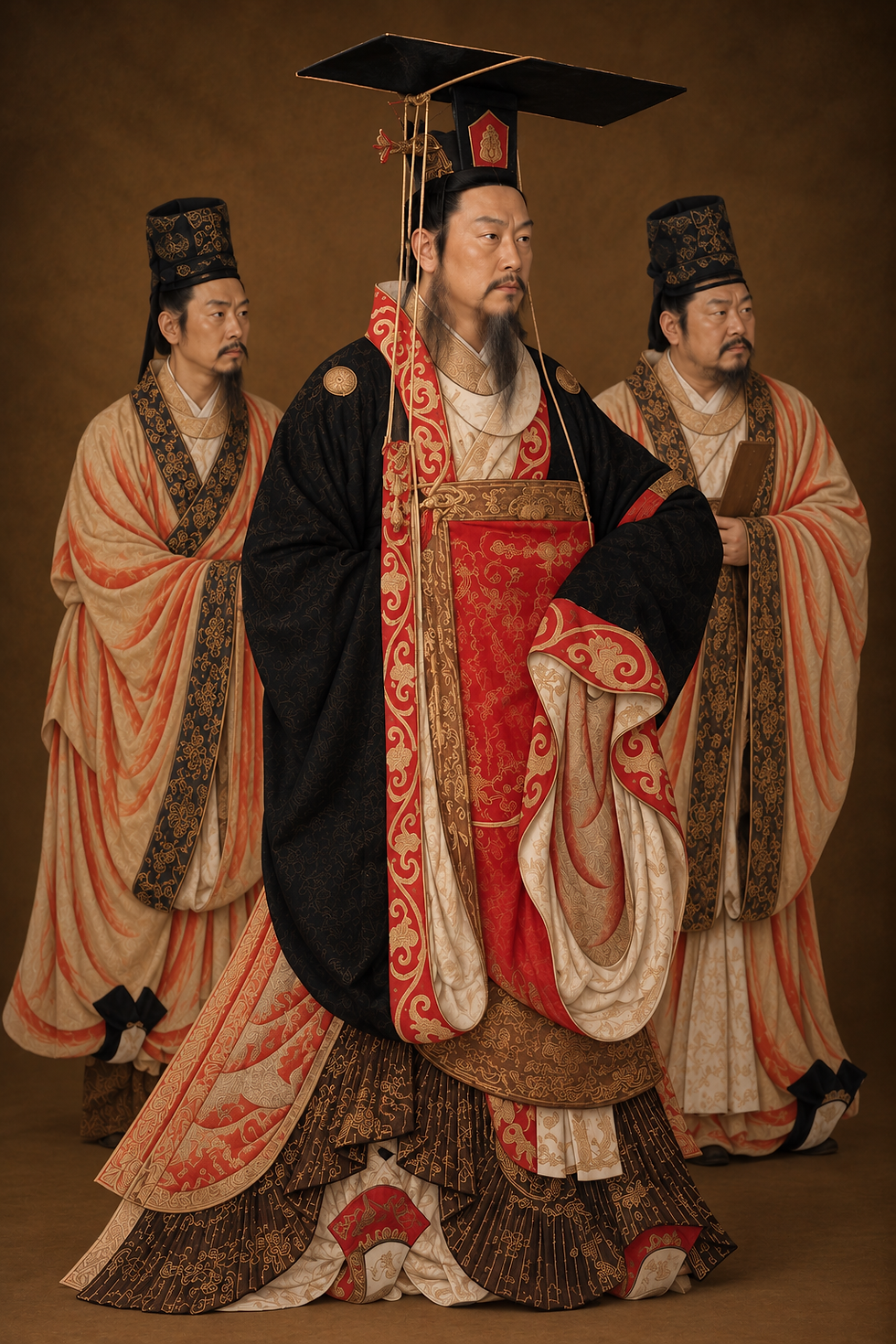
This AI-assisted photographic interpretation presents Emperor Wen at the height of his imperial authority.
Clothed in elaborate black, crimson and gold ceremonial robes, the emperor stands beneath the imposing silhouette of his imperial crown. The intricate embroidery and layered silks evoke the dignity, wealth and ceremonial traditions of the Chinese imperial court.
Two court officials stand behind him, their restrained expressions and formal attire symbolising the bureaucracy and administrative order upon which his empire was built.
The warm, subdued lighting recalls the atmosphere of an ancient imperial portrait, while the cinematic composition transforms a historical figure into a commanding, almost living presence.
His expression is deliberately contemplative rather than triumphant — that of a ruler who understood that conquering a kingdom was only the beginning, and that governing it required discipline, vision and determination.
Through the combination of historical inspiration, fine art photography and artificial intelligence, this portrait seeks to bridge fourteen centuries, imagining the human presence behind one of China’s most consequential emperors.
Emperor Wen did not merely establish a dynasty. He reunited a civilisation and helped lay the foundations for one of its greatest golden ages.


Comments