


Tropical Abundance 熱帶的豐饒 熱帯の豊かさ


“Tropical Abundance — Flowers of Southeast Asia” is an AI-assisted still life photography project celebrating the extraordinary botanical richness, colour and cultural diversity of Southeast Asia.
Across the series, flowers associated with the tropical landscapes of the region are gathered into elaborate, imaginary arrangements. Lotus, frangipani, orchids, heliconias, hibiscus and other luxuriant tropical blooms emerge among dense foliage, cascading branches and seed pods. Birds appear within each composition as living jewels, transforming the traditional flower arrangement into something closer to a miniature tropical habitat.
The images are deliberately abundant. Southeast Asia is represented not through restraint, but through profusion—flowers overlapping flowers, leaves spilling beyond the confines of their vessels and birds seemingly finding shelter among the branches. There is a sense that nature can barely be contained.
At the centre of every composition stands a vase.
These vessels provide another narrative running through the series. Their surfaces evoke the region’s long traditions of ceramics, carving and decorative craftsmanship: blue-and-white porcelain, richly ornamented earthenware, carved stone-like vessels, jade-green ceramics and elaborate painted surfaces. Architectural scenes, figures, birds and botanical motifs appear upon them, suggesting the different artistic histories that have developed throughout Southeast Asia.
The vase represents permanence; the flowers represent transience.
Together they create a dialogue between culture and nature, the manufactured and the living, history and the present.
A Botanical Portrait of a Region
Rather than attempting to create a scientific botanical record, the project imagines Southeast Asia through its visual vocabulary of flowers.
The lotus repeatedly emerges as one of the defining motifs. Rising pristine from muddy water, it carries profound spiritual associations throughout Buddhist and Hindu cultures and has become inseparable from the visual identity of much of the region.
Frangipani brings another familiar presence. Its simple white-and-yellow flowers evoke temple grounds, tropical gardens, humid evenings and the fragrance of Southeast Asian landscapes.
Elsewhere, extravagant orchids cascade from the arrangements, while heliconias introduce dramatic strokes of scarlet and orange. Hibiscus, flowering trees and pendulous tropical blooms add increasingly flamboyant forms until some compositions seem almost to overflow beyond the frame.
The flowers are accompanied by an equally varied collection of birds—from delicate, brilliantly coloured songbirds to pheasants, hornbills and waterbirds. Their presence gives each arrangement personality and movement. Some perch quietly among the blossoms; others command the composition with long tails, brilliant plumage or sculptural silhouettes.
They are not merely accessories to the flowers. They represent the extraordinary biodiversity that flowers alongside the human cultures of Southeast Asia.
Nine Imagined Gardens
Each photograph can be read as its own imaginary garden.
Some are luminous and ceremonial, filled with lotus blossoms and pale flowers against warm backgrounds. Others are darker and more mysterious, with orchids and tropical foliage emerging dramatically from deep green and blue surroundings. One composition explodes with scarlet tropical flowers; another is dominated by the extraordinary presence of a giant rafflesia beneath watchful hornbills.


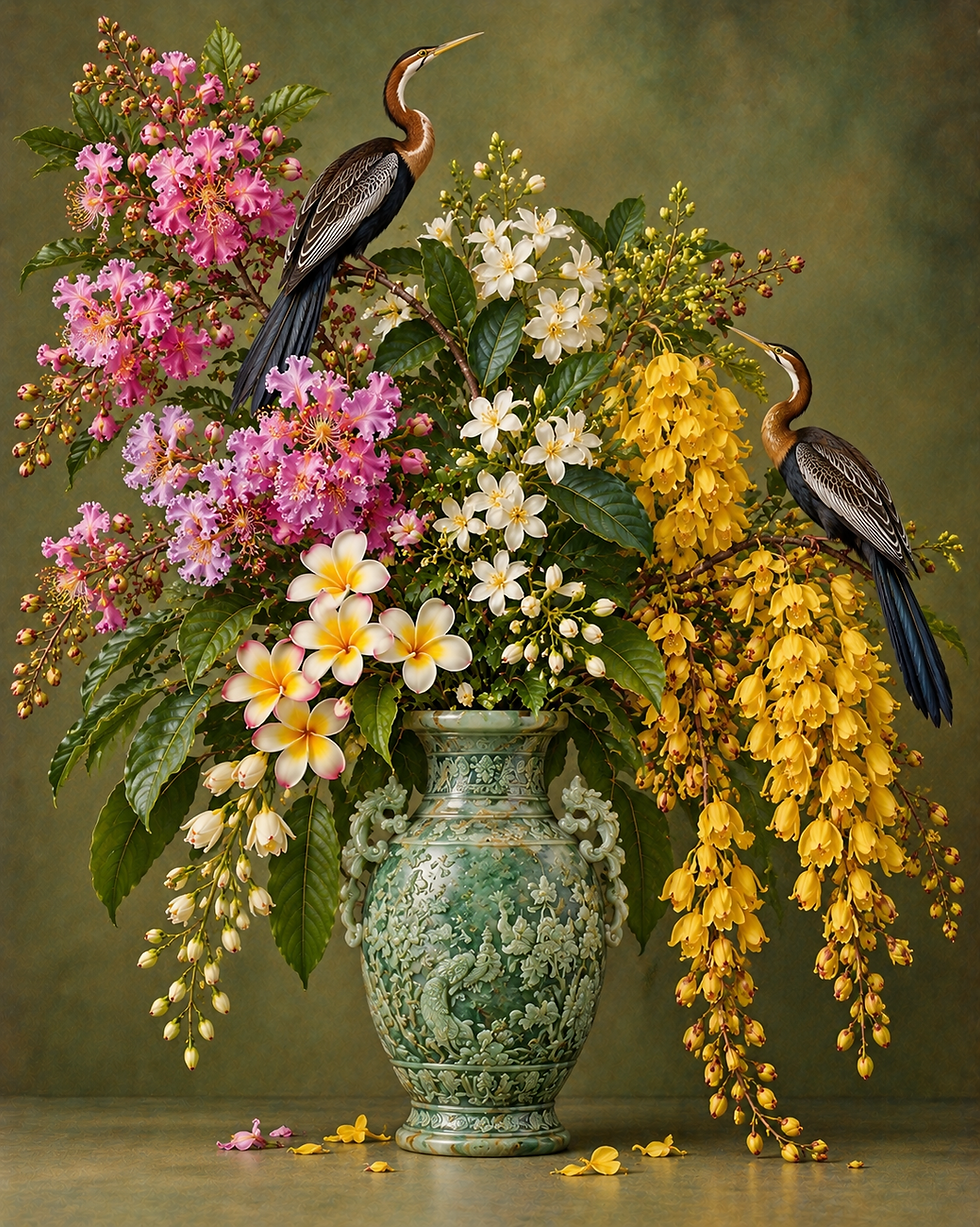
Seen together, the works move beyond individual countries. They form a visual journey through a broader Southeast Asian world—one connected by tropical climate and geography, yet distinguished by remarkably different traditions, landscapes and wildlife.
There are echoes of Thailand, Cambodia, Laos, Myanmar, Vietnam, Malaysia, Singapore, Indonesia and the Philippines, but the series is intentionally dreamlike rather than documentary. These are not literal flower arrangements one might encounter in a particular place. They are imagined botanical portraits assembled from memories, cultural associations and the visual language of the region.
Photography, Still Life and AI
The project also explores what still life photography can become when photography and artificial intelligence are allowed to intersect.
Traditional still life is constrained by physical reality: which flowers are available at the same moment, how long they remain fresh, whether particular birds could ever be photographed together and how gravity determines the final arrangement.
AI assistance removes many of those boundaries.


Flowers from different environments can bloom simultaneously. Birds can inhabit elaborate arrangements without disturbing a single petal. Branches can arc into improbable shapes and bouquets can achieve a scale and density closer to fantasy than floristry.
Yet the underlying aesthetic remains rooted in classical still-life portraiture. The controlled backgrounds, central compositions and carefully illuminated vessels recall painted botanical studies and the grand floral still lifes of earlier centuries.
The result occupies an uncertain space between photograph, painting, botanical fantasy and digital construction.
Ultimately, “Tropical Abundance — Flowers of Southeast Asia” is a celebration of a region where nature rarely whispers.
It grows, climbs, cascades and blooms.
Flowers become symbols of spirituality, place and memory. Birds become flashes of movement within otherwise frozen compositions. Ancient-looking vessels carry traces of human history beneath arrangements that appear capable of growing beyond them.
And within every image lies the same underlying idea: Southeast Asia is not represented by a single flower, colour or culture, but by abundance itself.
From top to bottom, the countries represented are Malaysia, Singapore, Thailand, Vietnam, Cambodia, Laos, Burma, Phillipines, Indonesia.


Comments