


Scream 驚聲尖叫 スクリーム


Created during the Venice Carnevale, this photo project takes the familiar elegance and mystery of the Venetian masquerade and pushes it into altogether darker territory. Inspired by the visual language of Scream, the photograph transforms a quiet Venetian passageway into the setting for a theatrical encounter with fear.
At the centre of the composition, the towering black-robed figure emerges from the darkness, its elongated, screaming face immediately evoking the unsettling imagery of the cult horror film. A human skull held forward becomes a macabre memento mori—a reminder of mortality that also feels strangely appropriate in Venice, a city whose history is filled with masks, plague, ritual and centuries-old legends.
Behind it stands a second masked figure, dressed in layers of black and blood-red fabric and holding a mysterious glass orb. Her stillness contrasts with the exaggerated terror of the figure in front. One appears almost violently animated; the other eerily calm, as though she already knows what is about to happen.
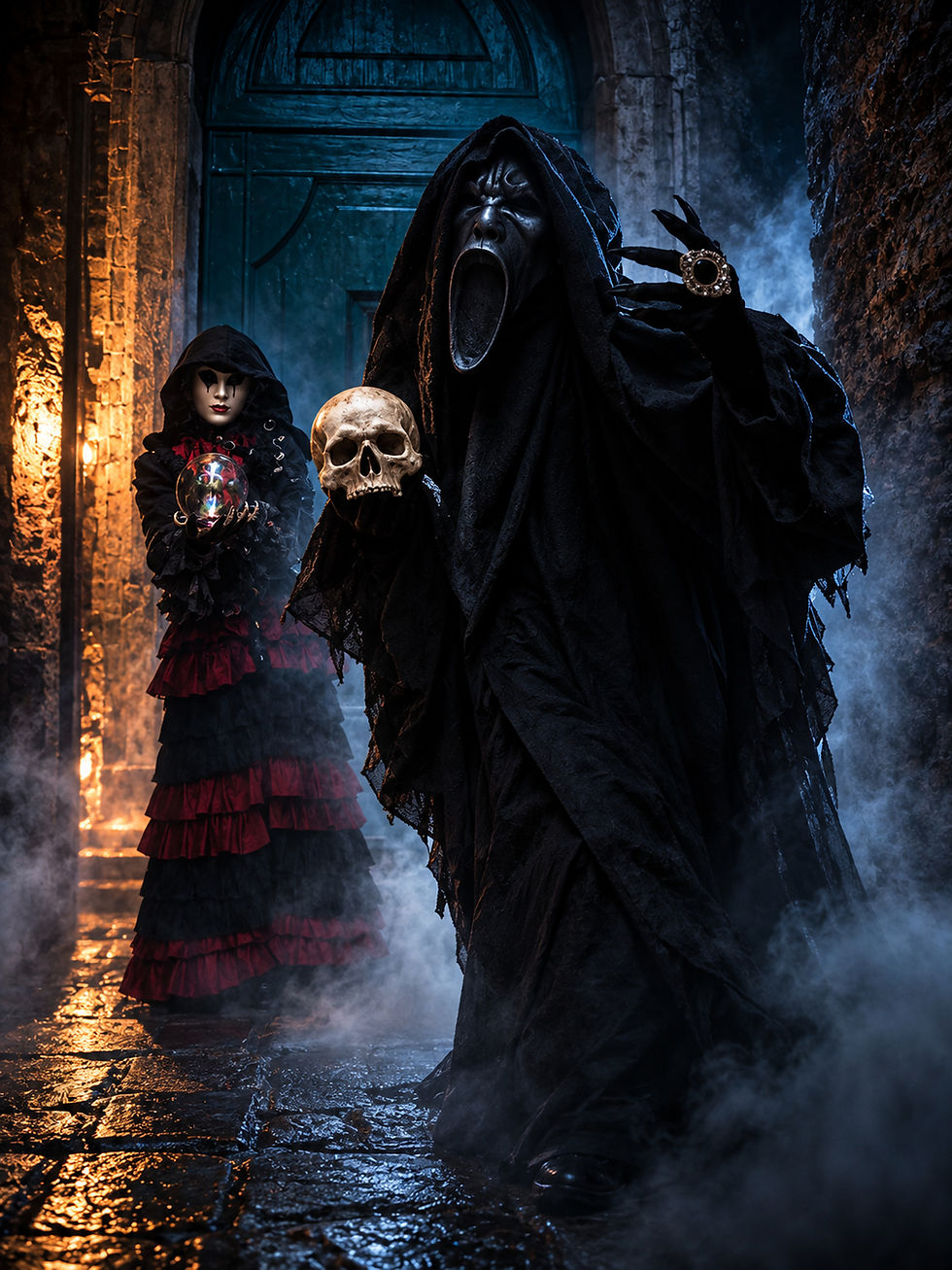

The dramatic reimagining intensifies the atmosphere of the original Carnevale portrait: cold blue light spills through the ancient doorway, warmer tones catch the crumbling stonework, and low mist creeps across the wet pavement. The narrow Venetian architecture seems to close around the characters, turning the street itself into part of the performance.
What interested me most was the collision of two very different traditions—the extravagant fantasy of Venice Carnevale and the instantly recognisable mood of modern cinematic horror. Carnevale has always been about transformation: behind a mask, identity disappears and another character is allowed to emerge. Scream takes that same idea of the mask and turns it into something threatening.
The result is less a conventional Carnevale portrait than a frame from an imaginary Venetian horror film—a moment suspended somewhere between masquerade, Gothic theatre and nightmare.
Scream is a 1996 American slasher film directed by Wes Craven and written by Kevin Williamson. It stars David Arquette, Neve Campbell, Courteney Cox, Matthew Lillard, Rose McGowan, Skeet Ulrich, and Drew Barrymore. Set in the fictional town of Woodsboro, California, the plot follows high school student Sidney Prescott (Campbell) and her friends as they become the targets of a costumed serial killer on the anniversary of her mother's murder.
Williamson, who was struggling to get his projects off the ground, was inspired by reports of the Gainesville Ripper murders to write a screenplay that satirized the clichés of the slasher genre popularized by films such as Halloween (1978), Friday the 13th (1980), and Craven's own A Nightmare on Elm Street (1984). Developed under the title Scary Movie, the script became the subject of an intense bidding war among multiple studios before Miramax Films purchased the rights for its Dimension Films label. Although Craven initially declined the project several times, he agreed to direct after reading the script, hoping to re-establish himself following a series of career setbacks. The involvement of the well-known Barrymore and Cox helped secure additional studio support. Principal photography took place in California from April to June 1996 on a budget of $15 million. Craven also trimmed the film's violence following a dispute with the Motion Picture Association of America over securing an R rating.
Released on December 20, Scream was not expected to perform well because of concerns about releasing a slasher film during the Christmas season. However, strong word of mouth helped it gross approximately $173 million worldwide, making it an unexpected success and one of the year's highest-grossing films. Contemporary reviews were positive, with praise directed toward the film's self-aware humor and effectiveness as a slasher film, although some felt its meta approach was overly irreverent.
In the years since its release, Scream has been regarded as a cultural touchstone and one of the most influential horror films of the 1990s. It has been credited with revitalizing the slasher genre and popularizing a self-aware, metatextual approach to horror that influenced numerous later works. Its opening sequence, in which Barrymore's character is unexpectedly killed, became particularly noted for its tension and subversion of audience expectations. The film's success launched a franchise, which includes the sequels Scream 2 (1997), Scream 3 (2000), Scream 4 (2011), Scream (2022), Scream VI (2023), and Scream 7 (2026), as well as an anthology television series.

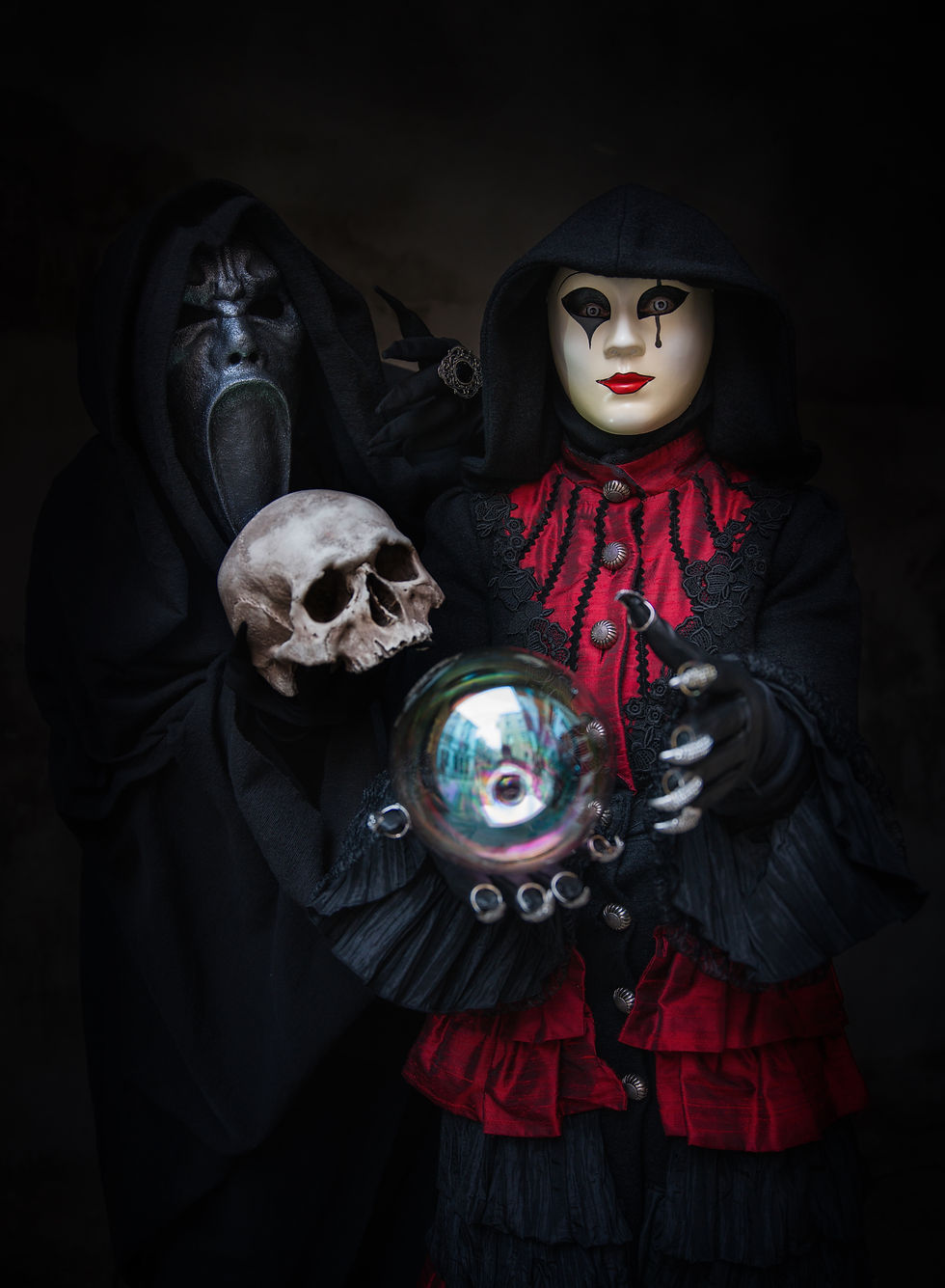


Antonio Monti and Moreta Montemurro are veteran costumers at the Venice Carnevale, well-known for their costumes of the dark side...we meet up every year for a short photo session.
Dark costumes are becoming an increasingly popular trend at the Venice Carnevale. This year, we did 2 short sessions, one at the famous green door and the other against a dark grey wall....


Comments