


The Book of Judith 友弟德傳 ユディト記


The Book of Judith is a deuterocanonical book included in the Septuagint and the Catholic, Eastern Orthodox, Oriental Orthodox, and Church of the East Old Testament of the Bible. It is excluded from the Hebrew canon and assigned by Protestants to the apocrypha. It tells of a Jewish widow, Judith, who uses her beauty and charm to kill an Assyrian general who has besieged her city, Bethulia. With this act, she saves nearby Jerusalem from total destruction. The name Judith (Hebrew: יְהוּדִית) meaning "praised" or "Jewess", is the feminine form of Judah.
The extant translated manuscripts from antiquity appear to contain several historical anachronisms, which is why the majority of modern scholars consider the book ahistorical. Instead, the book has been re-classified as a parable, theological novel, or even the first historical novel. Although the majority of Catholic scholars and clergy now view the book as fictional, the Catholic Church had traditionally maintained the book's historicity, assigning its events to the reign of King Manasseh of Judah and that the names were changed in later centuries for an unknown reason.
The beheading of Holofernes by Judith is recounted in the deuterocanonical Book of Judith, and is the subject of many paintings and sculptures from the Renaissance and Baroque periods. Artists have mainly chosen one of two possible scenes (with or without the servant): the decapitation, with Holofernes supine on the bed, or Judith the heroine holding or carrying the head.
Judith and Holofernes — A Venetian Carnevale Portrait...
Inspired by the dramatic story of Judith and Holofernes from the Book of Judith, this portrait created during the Venice Carnevale reimagines one of the most enduring subjects of Renaissance and Baroque art through the elaborate visual language of Venetian masquerade.
Judith, the beautiful and courageous widow of Bethulia, enters the camp of the Assyrian general Holofernes as her city faces destruction. Captivated by her, Holofernes welcomes Judith into his private quarters. After he becomes intoxicated and falls asleep, she takes his sword and beheads him, carrying his head back to Bethulia. The discovery throws the invading army into confusion and ultimately delivers her people from their enemy.
For centuries, the episode fascinated artists because of its extraordinary contrasts: beauty and brutality, seduction and danger, vulnerability and power. From Renaissance interpretations to the intensely theatrical paintings of the Baroque, Judith became an image not simply of violence, but of courage, determination and triumph against seemingly overwhelming power.
Here, the biblical narrative is transformed through the fantasy of the Venice Carnevale. The magnificent red-and-gold costume, cascading pearls, extravagant feathered hat and enigmatic red mask give Judith an almost otherworldly presence. Holofernes appears not as a scene of literal historical reconstruction, but as a theatrical Carnevale prop—a deliberate meeting between biblical iconography and the traditions of Venetian masquerade.
The painted setting extends this transformation. Deep shadows, sumptuous crimson fabrics, architectural grandeur and warm, directional light recall the chiaroscuro and theatricality of Baroque painting, while the distant Venetian lagoon anchors the fantasy unmistakably within the world of Venice.
The mask is perhaps the portrait’s most intriguing element. Judith’s expression is concealed, leaving the viewer unable to determine whether she feels triumph, horror, serenity or remorse. Behind the impassive face of the Carnevale mask, she becomes less an individual woman than an archetype: Judith the heroine, Judith the avenger, Judith the liberator.
Judith and Holofernes therefore becomes a meeting of three worlds—the ancient biblical legend, the dramatic visual tradition of Renaissance and Baroque Europe, and the extraordinary living theatre of the Venice Carnevale.
A biblical story becomes a masquerade; a masquerade becomes a painting; and for one moment, contemporary Venice slips back into the mysterious world of the Old Masters.
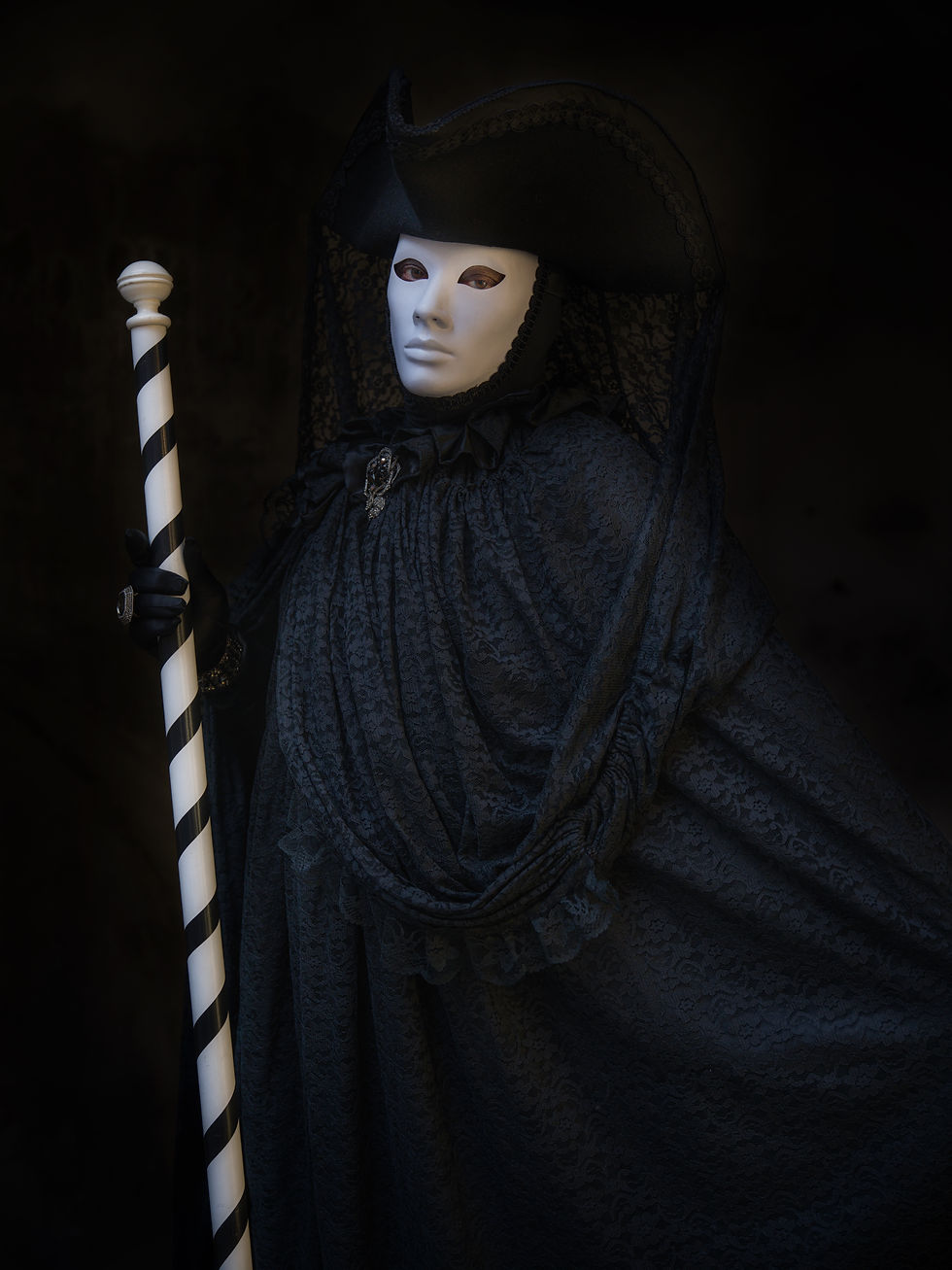
The Book of Judith by French costumer Quitterie Lesaule is a rather unusual costume for the Venice Carnevale. I haven't seen this theme presented before at my many years at the Venice Carnevale. This is a great addition to my collection of Venetian Mask photos.


Comments