


Las Hermanas de la Luna Negra 黑月姐妹 黒月の姉妹たち


Every winter, when the bells of Venice echoed through the fog and the canals turned black beneath the moonlight, the people whispered about two mysterious figures who appeared only during the final nights of the Carnevale.
They were called Las Hermanas de la Luna Negra — The Sisters of the Black Moon.
No one knew their true names.
Some claimed they came from Mexico centuries ago aboard a Spanish galleon filled with silver crosses, painted saints, and forbidden relics. Others believed they were spirits who emerged from the waters beneath Venice whenever the city grew too proud, too decadent, too forgetful of the dead.
But everyone remembered their faces.


White skull masks adorned with flowers of cobalt blue and violet. Golden crowns rising like cathedral halos. Long black gowns stitched with pearls that shimmered like moonlit rosaries. They moved silently through the narrow Venetian alleys as if gliding between worlds.
On the final evening of Carnevale in 1897, a young mask maker named Alessandro first saw them near the Bridge of Sighs.
The fog was thick that night.
Lanterns glowed faintly against the wet stone walls, and distant violins drifted from hidden palazzos where nobles danced behind locked doors. Alessandro had stayed late in his workshop near San Zaccaria, finishing an elaborate mask for a countess from Florence, when he noticed two women standing perfectly still at the end of the alley.
One carried blue roses.
The other held purple lilies.
Neither spoke.
Yet somehow Alessandro heard a whisper:
“Tonight, the dead walk beside the living.”
Drawn by something he could not explain, he followed them through the labyrinth of Venice. They passed beneath ancient archways, across silent bridges, and through deserted courtyards where candles flickered before forgotten Madonnas.
Wherever the sisters walked, strange things happened.
Old clocks began ticking again.
Extinguished candles relit themselves.
People standing alone in masks suddenly turned, believing they had glimpsed lost lovers, mothers, brothers, or children long buried beneath Venetian soil.
At midnight the sisters arrived at an abandoned palazzo overlooking the Grand Canal — a crumbling mansion once owned by a noble family destroyed by plague generations earlier.
Music echoed from inside.
Not modern music.
A waltz from another century.
Alessandro entered carefully.
The ballroom was filled with masked guests dressed in fashions from long ago: powdered wigs, velvet coats, lace gloves stained with age. They danced beneath chandeliers dripping with black crystals while flower petals rained from the ceiling like silent snow.
And none of them cast reflections in the mirrors.
The sisters stood at the center of the ballroom like queens of a forgotten kingdom.
Then the one crowned in blue finally removed her mask.
Beneath it was not death…
…but extraordinary sorrow.
Her face was young and beautiful, though pale as candle wax, and tears of blue paint ran like rivers down her cheeks.
“She died here,” whispered the violet sister.
Alessandro realized then that the ballroom was filled with souls trapped between memory and oblivion — spirits returning each Carnevale to dance one final night before fading again into darkness.
The blue sister had once been a Mexican opera singer who arrived in Venice decades earlier with a traveling theatre company. She had fallen in love with a Venetian composer during Carnevale, but both perished when fire consumed the palazzo during a masked ball.
Since then, she and her sister wandered the city every year beneath the Black Moon, gathering forgotten souls so they would not disappear alone.
As dawn approached, the ghosts slowly dissolved into silver mist.
The music faded.
Candles died one by one.
Before vanishing, the blue sister handed Alessandro a single blue rose.
“Remember us,” she said softly.
The next morning the palazzo stood empty and abandoned, its doors chained shut as though untouched for decades.
No trace of the ball remained.
Only one thing proved the night had been real:
A blue rose resting upon Alessandro’s worktable.


From that year onward, he created masks unlike any Venice had ever seen — masks painted with flowers, tears, saints, and moonlit skeletons. People traveled from across Europe to buy them, though Alessandro never explained the inspiration behind his designs.
And every Carnevale, on the final night before Lent, two silent women could still sometimes be seen drifting through the fog beside the canals of Venice.
One carrying blue roses.
The other purple lilies.
Waiting for the dead to dance once more beneath the Black Moon.
In Venice, the Day of the Dead (November 2nd, known as Il Giorno dei Morti or i morti) is a solemn, deeply moving tradition focused on visiting the island cemetery of San Michele. Locals honor deceased loved ones by bringing flowers and lighting candles, often taking free vaporettos to the island. While not a public holiday, it is a significant day of remembrance, marked by quiet reflection rather than the festive, party-focused atmosphere of Mexican Day of the Dead or American Halloween.
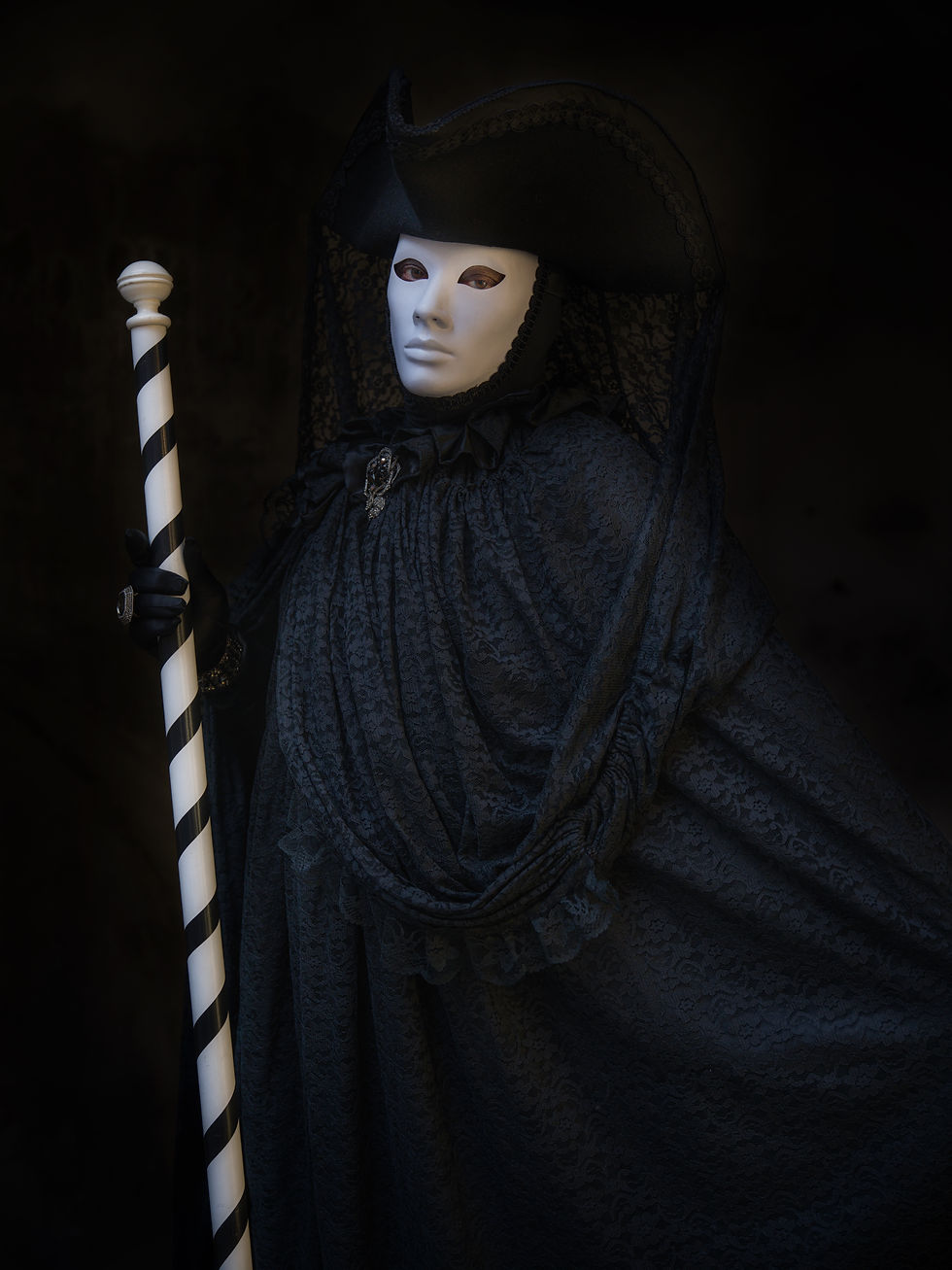
During Carnevale, Day of the Dead is becoming an increasingly popular theme. These portraits are from the Venice Carnevale, and the models come with the Venetian Mask versions of La Catrina.


Comments