


Fellowship of the Lake 湖畔團契 湖の仲間たち


Along the shadowed canals of Venice, where ancient stone meets dark water and the winter mist drifts quietly through forgotten passageways, five figures emerge as though summoned from another age.
Fellowship of the Lake brings together Mars, Athena, Hades, Persephone and Fortuna — five mythological forces reimagined through the extraordinary visual language of the Venice Carnevale.
In ancient Roman religion and mythology, Mars is the god of war and also an agricultural guardian, a combination characteristic of early Rome. He is the son of Jupiter and Juno, and was pre-eminent among the Roman army's military gods.
Mars represented military power as a way to secure peace, and was a father (pater) of the Roman people. In Rome's mythic genealogy and founding, Mars fathered Romulus and Remus through his rape of Rhea Silvia. The wolf was the sacred animal of Mars, with the she-wolf nursing the two founders as children. His love affair with Venus symbolically reconciled two different traditions of Rome's founding; Venus was the divine mother of the hero Aeneas, credited by Vergil as an earlier founder of Rome.
In Greek mythology, Athena was born from the forehead of her father Zeus; in Hesiod's Theogony, this occurred after Zeus swallowed his consort Metis while she was pregnant with Athena. In the founding myth of Athens, Athena bested Poseidon in a competition over patronage of the city by creating the first olive tree. She was known as Athena Parthenos "Athena the Virgin". In one archaic Attic myth, Hephaestus tried and failed to rape her, resulting in Gaia giving birth to Erichthonius, an important Athenian founding hero whom Athena raised. She was the patron goddess of heroic endeavour; she was believed to have aided the heroes Perseus, Heracles, Bellerophon, and Jason. Along with Aphrodite and Hera, Athena was one of the three goddesses whose feud resulted in the Trojan War. She plays an active role in the Iliad, in which she assists the Achaeans and, in the Odyssey, she is the tutelary deity to Odysseus.
In the later writings of the Roman poet Ovid, Athena was said to have competed against the mortal Arachne in a weaving competition, afterward transforming Arachne into the first spider, and to have transformed Medusa into the Gorgon after witnessing the young woman being raped by Poseidon in the goddess's temple. Ovid also says that Athena saved the mortal maiden Corone from the same god by transforming her into a crow. Since the Renaissance, Athena has become an international symbol of wisdom, the arts, and classical learning. Western artists and allegorists have often used Athena as a symbol of freedom and democracy.
Hades in the ancient Greek religion and mythology, is the god of the dead and riches and the King of the underworld, with which his name became synonymous. Hades was the eldest son of Cronus and Rhea, although this also made him the last son to be regurgitated by his father. He and his brothers, Zeus and Poseidon, defeated, overthrew, and replaced their father's generation of gods, the Titans, and claimed joint sovereignty over the cosmos. Hades received the underworld, Zeus the sky, and Poseidon the sea, with the solid earth, which was long the domain of Gaia, available to all three concurrently.
In ancient Greek mythology and religion, Persephone is the daughter of Zeus and Demeter. She became the queen of the underworld after her abduction by her uncle Hades, the king of the underworld, who later took her into marriage. The myth of her abduction, her sojourn in the underworld, and her cyclical return to the surface represents her functions as the embodiment of spring and the personification of vegetation, especially grain crops, which disappear into the earth when sown, remain hidden for a period, sprout from the earth, and are harvested when fully grown.
Fortuna, sometimes anglicized as Fortune, is the goddess of luck or fortune in Roman religion. She came to represent life's capriciousness, and was a goddess of fate. Fortuna remained popular through the Middle Ages until at least the Renaissance, largely thanks to the late antique author Boethius, in whose work she appears as a personification of the hidden will of God. The blindfolded depiction of her is still an important figure in many aspects of modern Italian culture, where the dichotomy of fortuna (good luck, fortune) and sfortuna (bad luck, misfortune) plays a prominent role in everyday social life, as represented in the common maxim La (dea) fortuna è cieca, "(The goddess) Luck is blind" (Latin Fortuna caeca est).


Mars stands as the embodiment of war and martial power, his crimson plume and Roman standard recalling the legions of antiquity. Beside him, Athena appears as the warrior goddess of wisdom and strategy, resplendent in gold, shield in hand, both guardian and sovereign.
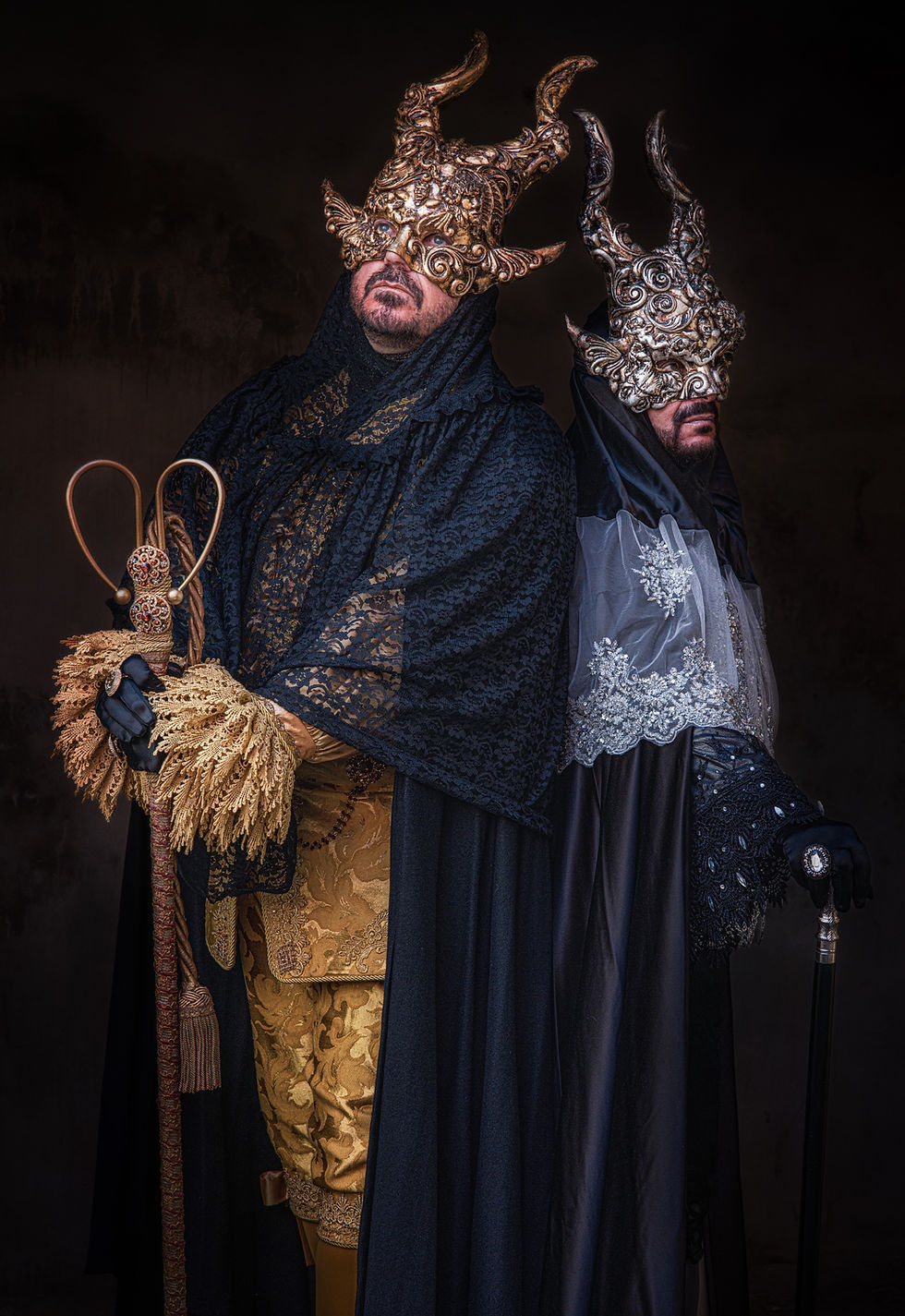
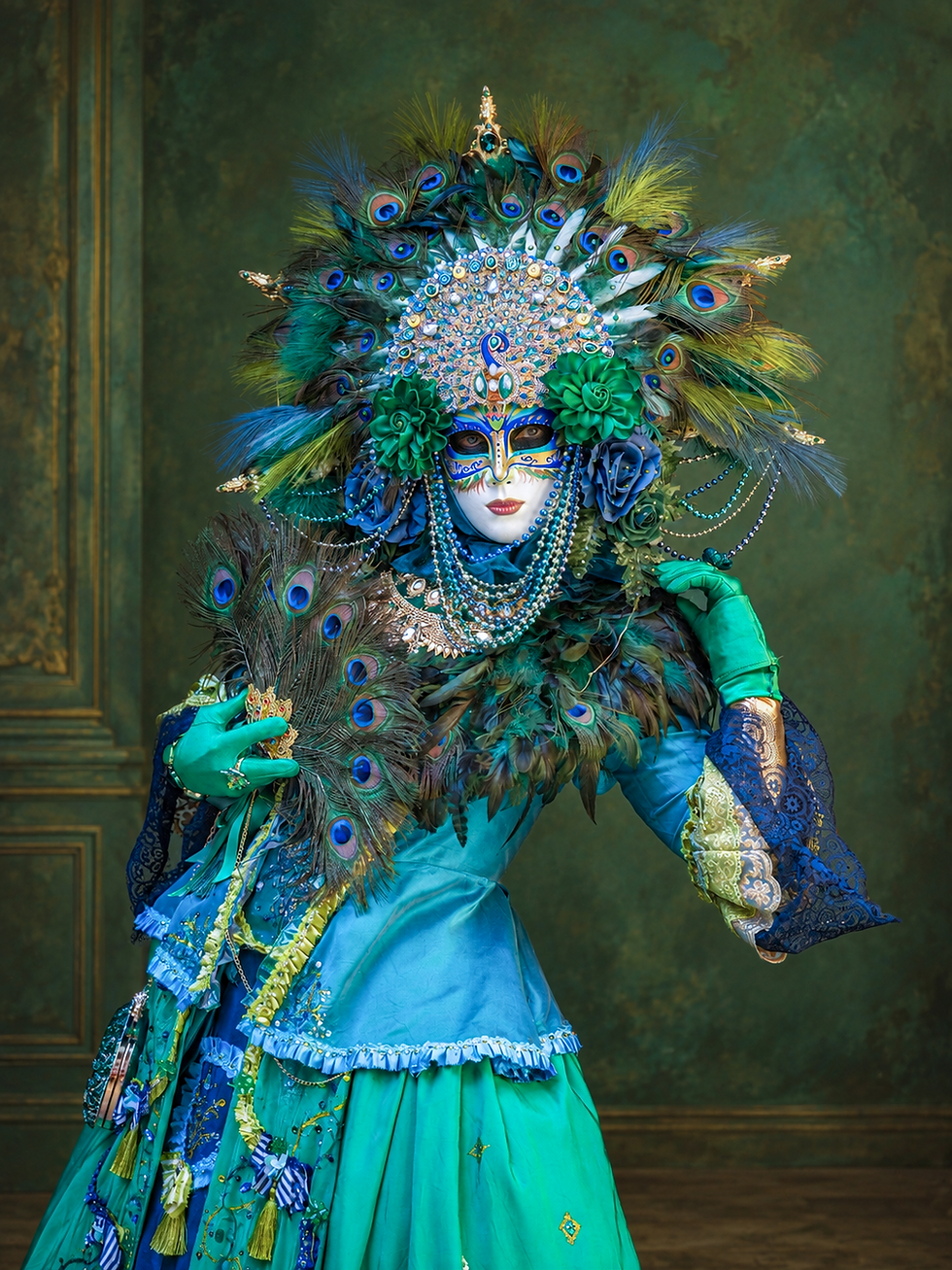
From a darker realm comes Hades, keeper of the Underworld, carrying the unmistakable symbol of mortality. Persephone provides a striking counterpoint: surrounded by flowers, fruit and deep green fabric, she represents both life and death — the eternal passage between the fertile world above and the kingdom beneath.
And presiding over this strange gathering is Fortuna, goddess of fate and fortune, accompanied by the wheel that has symbolised the unpredictable turning of human destiny for centuries.
Together they become something more than five individual costumes. They form a fellowship — warriors, rulers and gods gathered beside the waters of Venice, each representing a different force governing human existence: war, wisdom, death, rebirth and fate.


The setting transforms the narrow Venetian canal into an imagined boundary between worlds. Mist rises from the water, weathered brickwork disappears into the shadows, and the elaborate masks conceal every trace of ordinary identity. For a fleeting moment during Carnevale, mythology seems to have crossed into reality.
Fellowship of the Lake is ultimately a portrait of that transformation — a meeting of classical mythology, Venetian theatricality and contemporary costume artistry, photographed in a city where history and fantasy have always existed side by side.

Comments