


Doraemon 哆啦A夢ドラえもん
- Robin Yong

- 3 hours ago
- 6 min read

Doraemon (ドラえもん) is a Japanese manga series written and illustrated by Fujiko F. Fujio. First serialized in 1969, the manga's chapters were collected in 45 tankōbon volumes published by Shogakukan from 1974 to 1996. The story revolves around an earless robotic cat named Doraemon, who travels back in time from the 22nd century to assist a boy named Nobita Nobi in his day-to-day life.
The manga spawned a media franchise. It was adapted into three different anime TV series in 1973, 1979, and 2005. Additionally, Shin-Ei Animation has produced over forty animated films, including two 3D computer-animated films, all of which are distributed by Toho. Various types of merchandise and media have been developed, including soundtrack albums, video games, and musicals. The manga series was licensed for an English language release in North America, via Amazon Kindle, through a collaboration of Fujiko F. Fujio Pro with Voyager Japan and AltJapan Co., Ltd. The anime series was licensed by Disney for an English-language release in North America in 2014, and LUK International in Europe, the Middle East and Africa.
Doraemon was well received by critics and became a commercial success in many Asian countries. It won numerous awards, including the Japan Cartoonists Association Award in 1973 and 1994, the Shogakukan Manga Award for children's manga in 1982, and the Tezuka Osamu Cultural Prize in 1997. As of 2024, it has sold over 300 million copies worldwide, making it one of the best-selling manga series of all time. The character of Doraemon is considered a Japanese cultural icon, and was appointed as the first "anime ambassador" in 2008 by the country's Foreign Ministry.


In the 20th or 21st century (2005 TV series and manga) in Tokyo, Nobita Nobi is a ten-year-old Japanese school boy who is kind-hearted and honest, but also lazy, clumsy, and hapless, performing poorly in both school and sports. One day, a blue robot cat from the 22nd century named Doraemon is sent back to the past by Nobita's future great-great-grandson, Sewashi Nobi, to take care of Nobita so that his descendants can have a better life. Doraemon has a four-dimensional pocket in which he stores tools, inventions, and gadgets from the future to aid Nobita whenever he is faced with a problem. Although Doraemon is a cat robot, he has a fear of mice because of an incident where robotic mice chewed off his ears. This is why Doraemon lost his original yellow color and turned blue, from sadness.
Nobita has three main friends: Takeshi Goda (nicknamed Gian), Suneo Honekawa (Gian's sidekick), and Shizuka Minamoto, Nobita's best friend and love-interest. Gian is a strong, leading and domineering boy, but also loyal to his friends. Suneo is a wealthy and spoiled boy who uses his friendship with Gian to win the respect of other schoolmates. Shizuka is a gentle and kind girl who frequently plays with Nobita. Nobita has a crush on Shizuka; she is his prospective future wife (Nobita's future wife is initially Gian's younger sister). Although Gian and Suneo are Nobita's friends, they also typically bully and abuse him. Nobita normally responds by using Doraemon's gadgets to fight back against them, but Nobita has a tendency to get carried away with using the gadgets (or Gian and Suneo, if they steal it away), which typically results in unintended consequences for him and others.
In addition to Gian, Suneo, and Shizuka, Dorami and Hidetoshi Dekisugi are also recurring characters. Dorami is Doraemon's younger sister, and Dekisugi is a gifted student boy who as Shizuka's close friend, frequently attracts the jealousy of Nobita.

The name "Doraemon" can be roughly translated to "stray". Unusually, the name "Doraemon" (ドラえもん) is written in a mixture of two Japanese scripts: katakana (ドラ) and hiragana (えもん). "Dora" derives from "dora neko" (どら猫; stray cat), and is a corruption of nora ("stray"), while "-emon" (in kanji 右衛門) is an old-fashioned suffix for male names (for example, as in Ishikawa Goemon).

The name "Nobita Nobi" refers to "nobi nobi", meaning "the way a young child grows up free, healthy, and happy, unrestrained in any sense".
The name "Tsukimidai-Susukigahara", the fictional neighborhood in Nerima Ward, Tokyo where Nobita Nobi and his friends live, refers to the Fujimidai neighborhood, where Osamu Tezuka's residence and animation studio, Mushi Production, is based.


The series ceased its original run in 1994 and was not given an ending before Fujimoto's death in 1996; this has since aroused numerous urban legends throughout the years. One of the most well-known "endings" of the manga was by an amateur manga cartoonist under the pen name "Yasue T. Tajima", first appearing on the Internet in 1998 and made into a manga in 2005. The story takes place when Doraemon's battery dies, and Nobita later grows up becoming a robot engineer, potentially reviving Doraemon and live a happy life. Tajima issued an apology making his own ending in 2007, and the profits were shared with Shogakukan and the copyright owner, Fujiko F. Fujio Pro.
Ryūichi Yagi and Takashi Yamazaki, the directors of Stand by Me Doraemon, confirmed that it had only one opening, while the ending has been rewritten several times. Because of this, Shogakukan had to clarify that only if the marriage of Nobita and Shizuka is finalized will the mission be accomplished, and then Doraemon will return to the future.

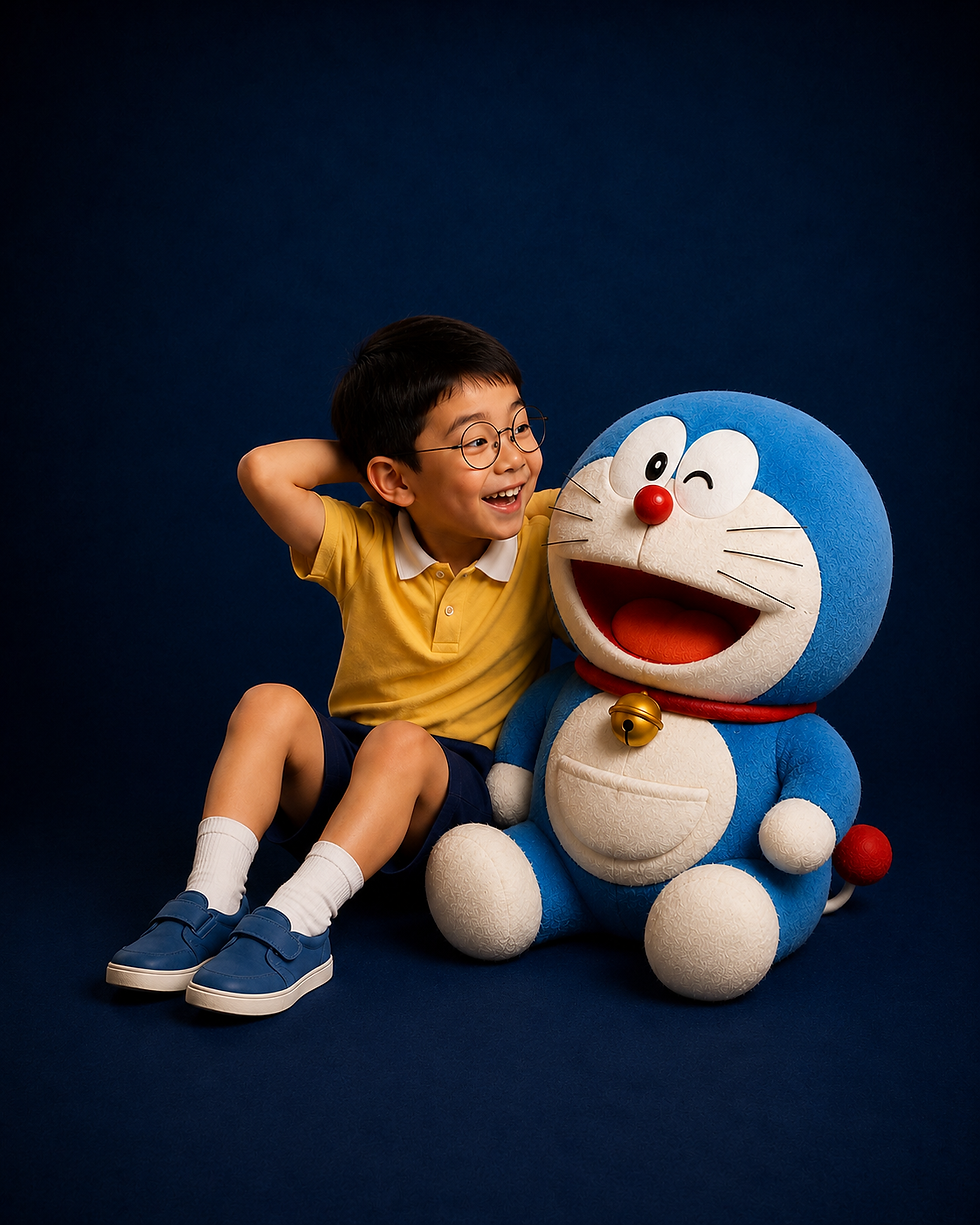
This photo series is a celebration of friendship, imagination, and the timeless charm of one of Japan’s most beloved animated icons. Inspired by the enduring adventures of Nobita, Doraemon, Dorami, and Shizuka, the project reinterprets these classic characters through a blend of AI-assisted portrait photography, costume design, and digital artistry. Rather than recreating scenes directly from the original animation, the collection imagines how these familiar personalities might appear in richly lit photographic worlds while preserving the innocence, warmth, and optimism that have made them cultural icons for generations.
Each image explores a different visual narrative. Some portraits present Nobita interacting with a soft, plush-like Doraemon in an intimate studio setting, emphasizing the companionship that lies at the heart of the series. Others transport the pair onto whimsical floating clouds or playful fantasy adventures, while another imagines them as cheerful explorers in Western-inspired attire. The group portrait extends this concept further by bringing together Nobita, Doraemon, Dorami, and Shizuka in a harmonious composition that blends traditional East Asian elements with modern portrait photography.
A defining artistic choice throughout the project is the contrast between realism and fantasy. The human characters are portrayed as lifelike children with expressive faces, natural skin tones, and authentic studio lighting, while Doraemon and Dorami deliberately remain stylized, plush-like, non-human companions. This preserves their iconic identities and reinforces the magical coexistence of reality and imagination, allowing viewers to immediately recognize the beloved robotic cats without losing the illusion of a photographic world.
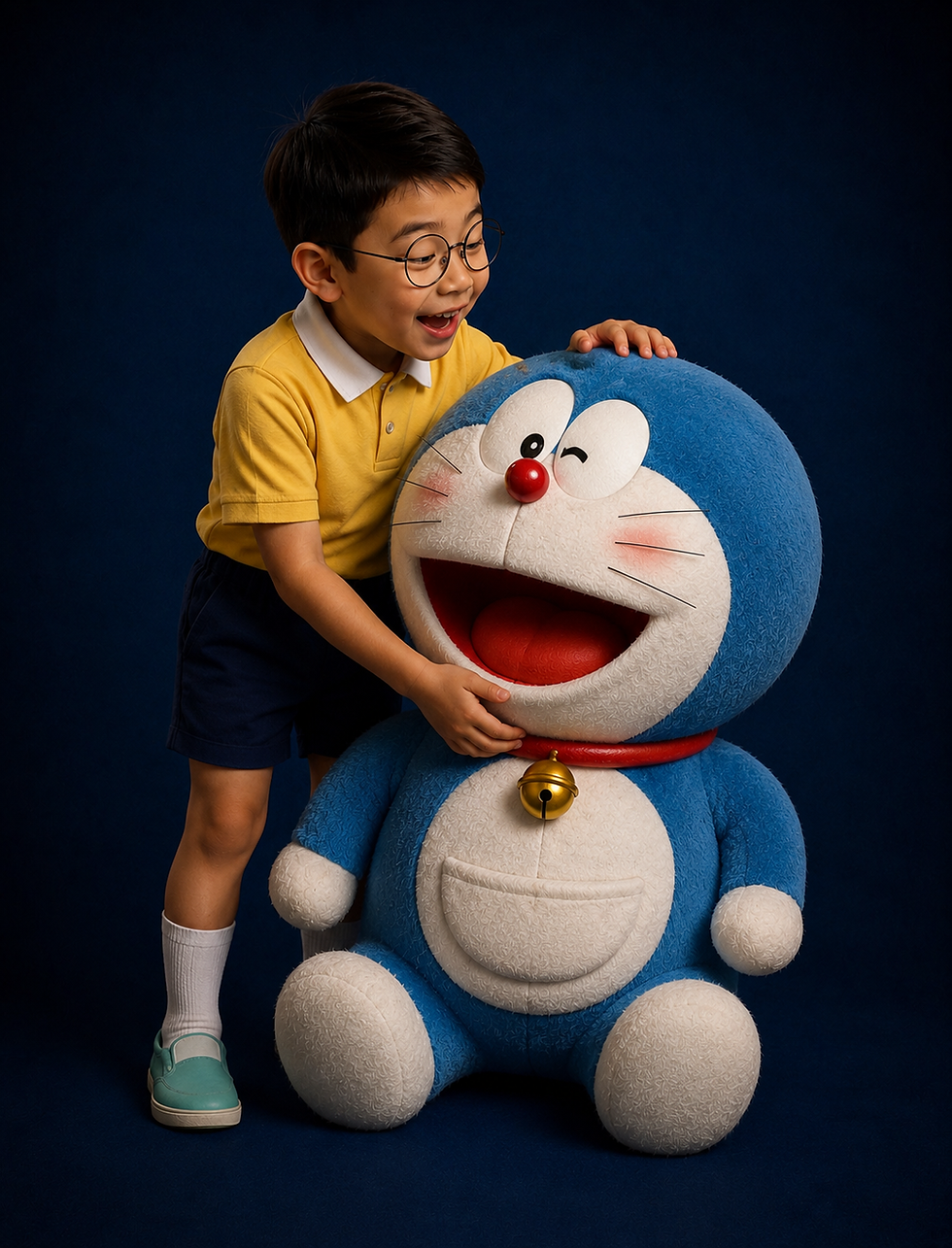

Visually, the series embraces a consistent cinematic language. Deep navy backdrops, carefully controlled studio lighting, warm skin tones, and subtle shadows create portraits reminiscent of fine-art children’s photography. The soft textures of the mascots contrast beautifully with the realistic fabrics and skin of the human subjects, producing an image that feels simultaneously nostalgic and contemporary.
Beyond its technical execution, the project celebrates the universal themes that have defined the Doraemon franchise for over half a century: curiosity, friendship, courage, kindness, and the belief that extraordinary adventures often begin with ordinary children. Whether seated together on a cloud, sharing a laugh in a studio, or embarking on imaginary journeys, these portraits invite viewers to rediscover the sense of wonder that childhood stories continue to inspire.
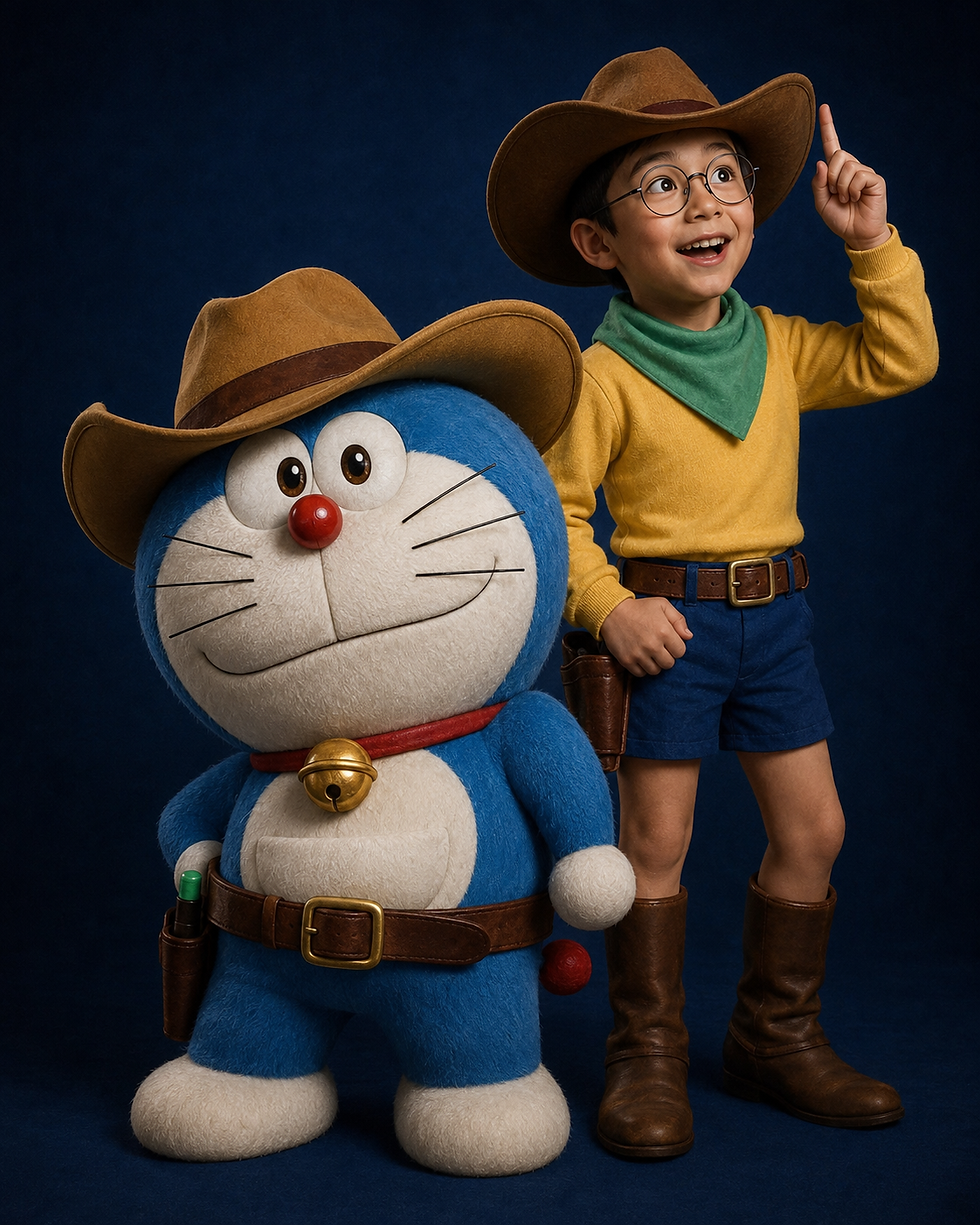
The photo project is both a tribute to a cherished cultural phenomenon and an exploration of how AI-assisted creative tools can expand the possibilities of cosplay and fan art. By combining traditional portrait photography with imaginative digital craftsmanship, the series offers a fresh interpretation of familiar characters while remaining faithful to the joyful spirit that has made Doraemon a beloved companion to audiences around the world.
Disclaimer: This is a non-commercial fanart and cosplay project created for artistic appreciation and creative expression. Characters and concepts are inspired by Fujiko F. Fujio, Shogakukan and Tentōmushi Comics. AI-assisted tools were used as part of the artistic workflow alongside photography, costume design, and digital post-production. The fanart photo project is created as a non-commercial tribute to the original doll series and its enduring legacy in popular culture.


Comments