


Album of Yuan Empress Portraits 元代后像冊 Юань хатан хааны хөрөг зургийн цомог


Yuan dynasty empress portraits are renowned for blending nomadic Mongol traditions with Han Chinese imperial aesthetics. Most surviving examples are preserved in the National Palace Museum in Taipei and the Palace Museum in Beijing.
Among surviving imperial portraits of the Mongol Yuan rulers, two of the most well-known sources are the National Palace Museum's "Album of Yuan Emperor Portraits" and "Album of Yuan Empress Portraits" (collectively known as "Albums of Yuan Imperial Portraits").
Album of Yuan Empress Portraits artworks are celebrated for several distinct characteristics:
The Gugu Hat (Gugu Guan): Empresses are prominently depicted wearing tall, cylindrical headdresses made of birch bark or wire and wrapped in red silk, which were characteristic of married Mongol noblewomen.
Islamic Gold Brocade: Their robes frequently feature intricate gold-threaded patterns known as nasij (or nashishi), which reflects the cross-continental trade and Islamic influence prevalent in the Mongol Empire.
Facial Modeling: Unlike traditional, flat Chinese portraiture, Yuan artists used delicate shading to emphasize the contours of the face, such as the eye sockets and cheeks, borrowing techniques from Central Asian or Persian traditions.
Specific Examples: Notable surviving portraits include depictions of Empress Chabi (favorite wife of Kublai Khan) and Empress Taji.

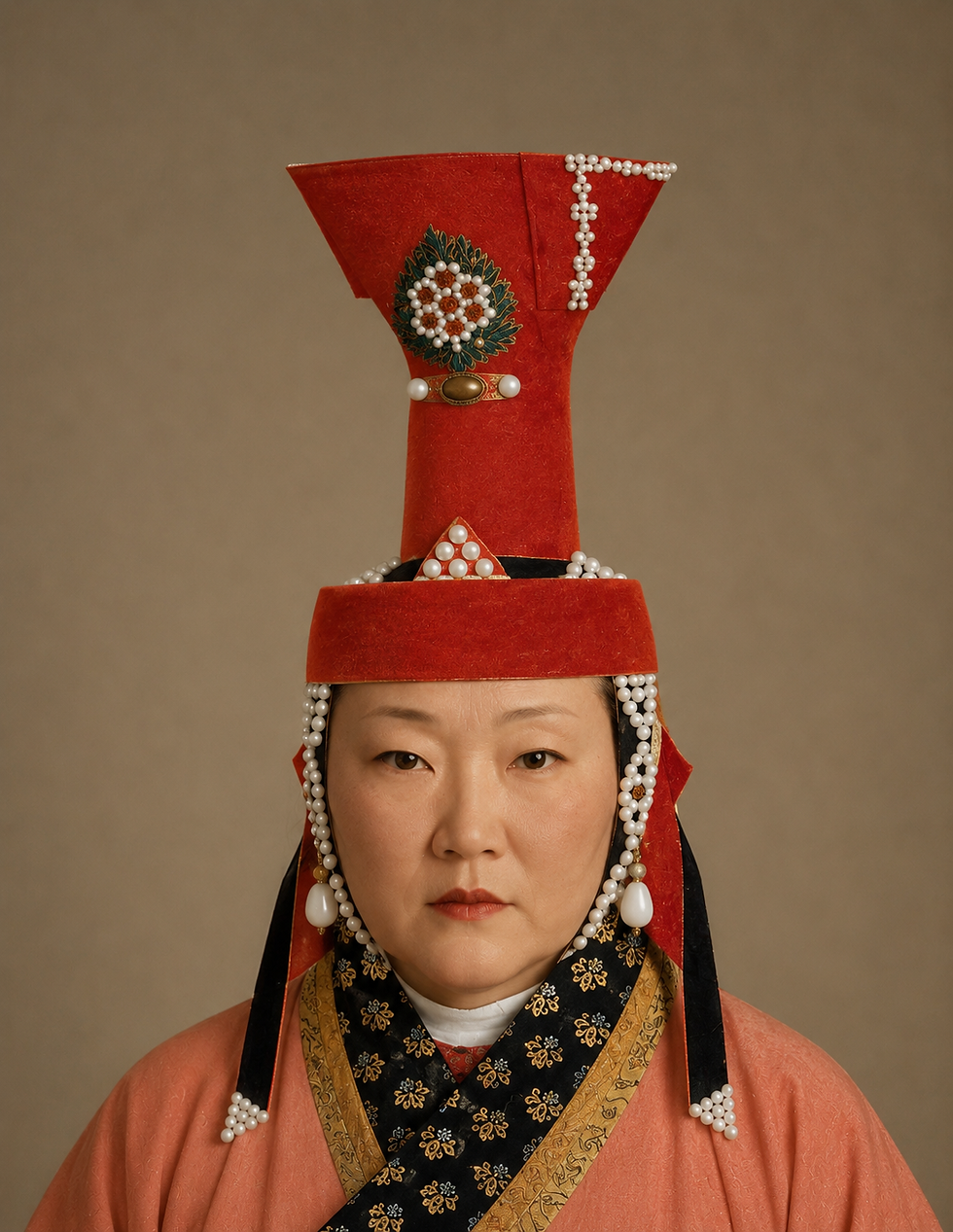

This AI-assisted cosplay photography series pays homage to the remarkable imperial portraiture of the Yuan dynasty (1271–1368), an era in which the Mongol rulers of China blended the traditions of the Eurasian steppe with the refined artistic conventions of the Chinese imperial court. Inspired by surviving portraits of Yuan empresses, the collection reimagines these historical figures as living women while remaining faithful to the solemn dignity and restrained elegance that define the originals.
Rather than romanticizing the past, the project seeks to breathe life into centuries-old paintings through photorealistic interpretation. The empresses are portrayed with calm, unwavering expressions, emphasizing authority, wisdom, and composure over overt emotion. Their forward-facing gaze mirrors the formal court portraits commissioned to preserve the likeness and legitimacy of the imperial family, where symbolism and ceremonial precision were considered more important than dramatic expression.
Particular attention has been given to the distinctive ceremonial attire of the Yuan court. The towering scarlet gugu headdress—one of the most recognizable elements of Mongol aristocratic fashion—dominates each portrait, standing as a symbol of imperial status and cultural identity. Pearl ornaments, jade fittings, embroidered collars, and richly woven robes have been recreated with painstaking detail, transforming painted motifs into tangible textiles that appear handcrafted from silk, gold thread, and precious stones.
The subdued lighting and neutral studio backdrop echo the timeless simplicity of museum photography, allowing the viewer to focus entirely on the face, costume, and regalia. Warm earth tones and restrained color grading evoke the texture of aged silk paintings while maintaining the realism expected of contemporary portrait photography.
Although created with the assistance of artificial intelligence, these images are intended as an artistic interpretation rather than a historical reconstruction. They explore how modern technology can bridge the gap between medieval portraiture and contemporary visual storytelling, inviting viewers to imagine how the empresses of the Mongol Empire might have appeared if photographed with today’s cameras.

Ultimately, this collection celebrates the unique cultural synthesis of the Yuan dynasty—a period when Mongol traditions, Chinese craftsmanship, and imperial ceremony merged into a distinctive visual language. By transforming these iconic portraits into lifelike photographic studies, the project offers a respectful tribute to one of East Asia’s most fascinating royal courts while demonstrating how AI can serve as a powerful medium for preserving and reinterpreting cultural heritage.


Comments