


Pulcinello e Pantelone 普爾奇內洛與潘塔隆 プルチネッロとパンテローネ

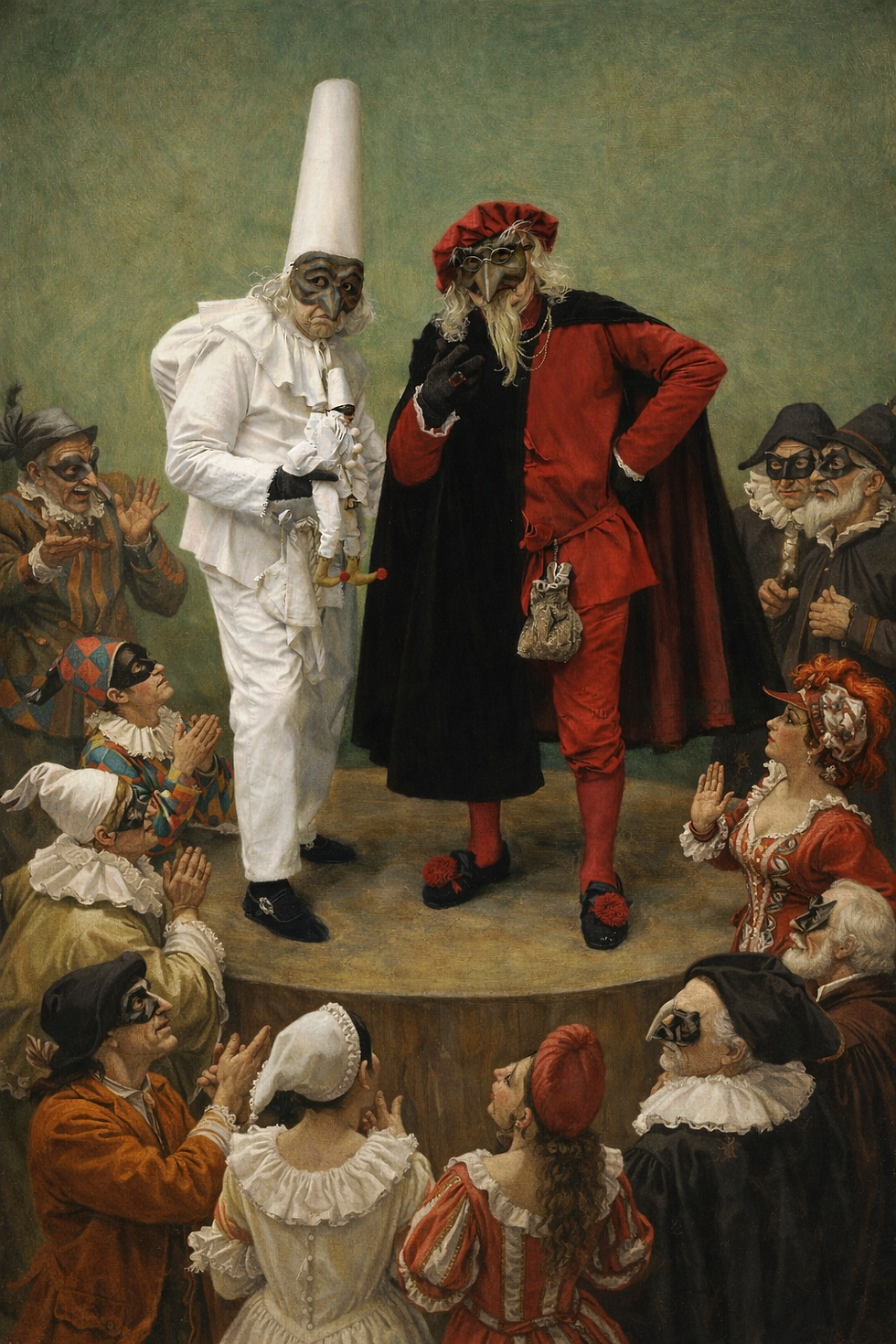
Pulcinella and Pantalone are iconic, contrasting stock characters from the 16th-century Italian commedia dell'arte. Pantalone is a greedy, lustful, and often deceived Venetian merchant, typically acting as a father figure obstructing young lovers. Pulcinella is a contradictory, chicken-like servant figure representing raw instincts, often depicted as a clever yet cowardly.
The bells of San Marco had only just finished their morning toll when the square filled with laughter, silk, and secrets.


It was Carnevale in Venice, the year of our Lord 1570—a time when truth hid behind masks and lies danced openly in the sunlight.
At the center of a hastily raised wooden stage stood two figures who could never truly hide, no matter how ornate their disguises.
Pulcinello, dressed in his exaggerated white—his belly full, his posture crooked, his voice always on the edge of laughter—clutched a small puppet dangling from his hand as if it were a noble scepter. His mask, long-nosed and sharp-eyed, betrayed mischief even when he stood still.
Beside him stood Pantelone—rich, red, and restless. His robes were of fine cloth, his purse heavy, and his temper heavier still. A black cloak draped over his shoulders like a shadow he could not escape. His mask, hooked and severe, suggested wisdom… but his eyes betrayed something closer to anxiety.
Around them gathered the crowd: lovers, beggars, merchants, courtesans—all equal beneath their masks. They leaned in, whispering, clapping, hungry for spectacle.
Pulcinello bowed deeply, nearly toppling over.
“Signori! Signore! Today we present a tale of wealth, wisdom, and—most importantly—poor decisions!” he declared, his voice cracking like old wood.
The crowd laughed.
Pantelone stepped forward, offended. “Poor decisions? I am the wealthiest merchant in Venice! My decisions built palaces!”
Pulcinello tilted his head. “And emptied hearts, perhaps?”
A murmur rippled through the audience.
Pantelone bristled. “What would you know of hearts, fool? You have none—only hunger and tricks!”
Pulcinello lifted his puppet and made it speak in a squeaky voice. “And yet, dear Pantelone, even a puppet knows when a man is ruled by his purse.”
The crowd roared.
Pantelone’s gloved hand tightened at his side. “This is not the play we agreed upon.”
Pulcinello leaned in closer, his voice lowering. “Ah… but it is the play Venice wants.”
And that was the danger of Carnevale.
Because here, under the freedom of masks, truth slipped out like wine from a cracked cup.
Pantelone turned to the crowd, forcing a laugh. “Very well! Let us play along. Tell me then, Pulcinello—what does a poor fool know of riches?”
Pulcinello straightened, suddenly still.


“Riches?” he said softly. “They are like this Carnevale. Beautiful, dazzling… and gone by Lent.”
The laughter faltered.
Pantelone scoffed. “My wealth does not vanish.”
Pulcinello raised an eyebrow. “No? Then why do you clutch your purse even now?”
Pantelone instinctively covered the small pouch at his waist.
The crowd noticed.
A ripple of knowing laughter returned—this time sharper.
Pulcinello stepped forward, circling him slowly like a fox around a henhouse. “You see, dear Pantelone… you are the richest man in Venice—and yet the poorest.”
Pantelone’s voice dropped. “Explain yourself.”
Pulcinello gestured to the crowd. “Look at them. They laugh, they love, they forget themselves. Today they are kings and queens without coin.”
He tapped Pantelone’s purse.
“And you? Even today… you remain a prisoner.”
Silence fell.

For a moment, the masks seemed thinner. The game, too real.
Pantelone looked around—the people watching, judging, enjoying his discomfort. His pride burned hotter than any insult.
“You think yourself clever,” he said quietly. “But without men like me, there would be no Venice. No trade. No wealth. No Carnevale.”
Pulcinello smiled.
“And without fools like me… there would be no truth.”
A pause.
Then—unexpectedly—Pantelone laughed.
Not the sharp, defensive laugh of a merchant—but something deeper, almost… free.
“You are a dangerous creature, Pulcinello.”
“And you,” Pulcinello replied, bowing, “are finally entertaining.”
The crowd erupted—clapping, cheering, shouting.
The tension broke like a wave against stone.
Pantelone reached into his purse.
Gasps.
He hesitated… then tossed a handful of coins into the crowd.
Children scrambled, lovers laughed, even the stern-faced elders bent to gather silver.
Pulcinello blinked in surprise.
Pantelone leaned closer. “Just for today.”
Pulcinello grinned. “That is all Carnevale ever promises.”
The bells began to ring again.
The moment passed.
The masks held.
And Venice, eternal and fleeting, carried on—where fools spoke truth, merchants played at generosity, and for a single day, even the richest man could almost forget what he feared to lose.
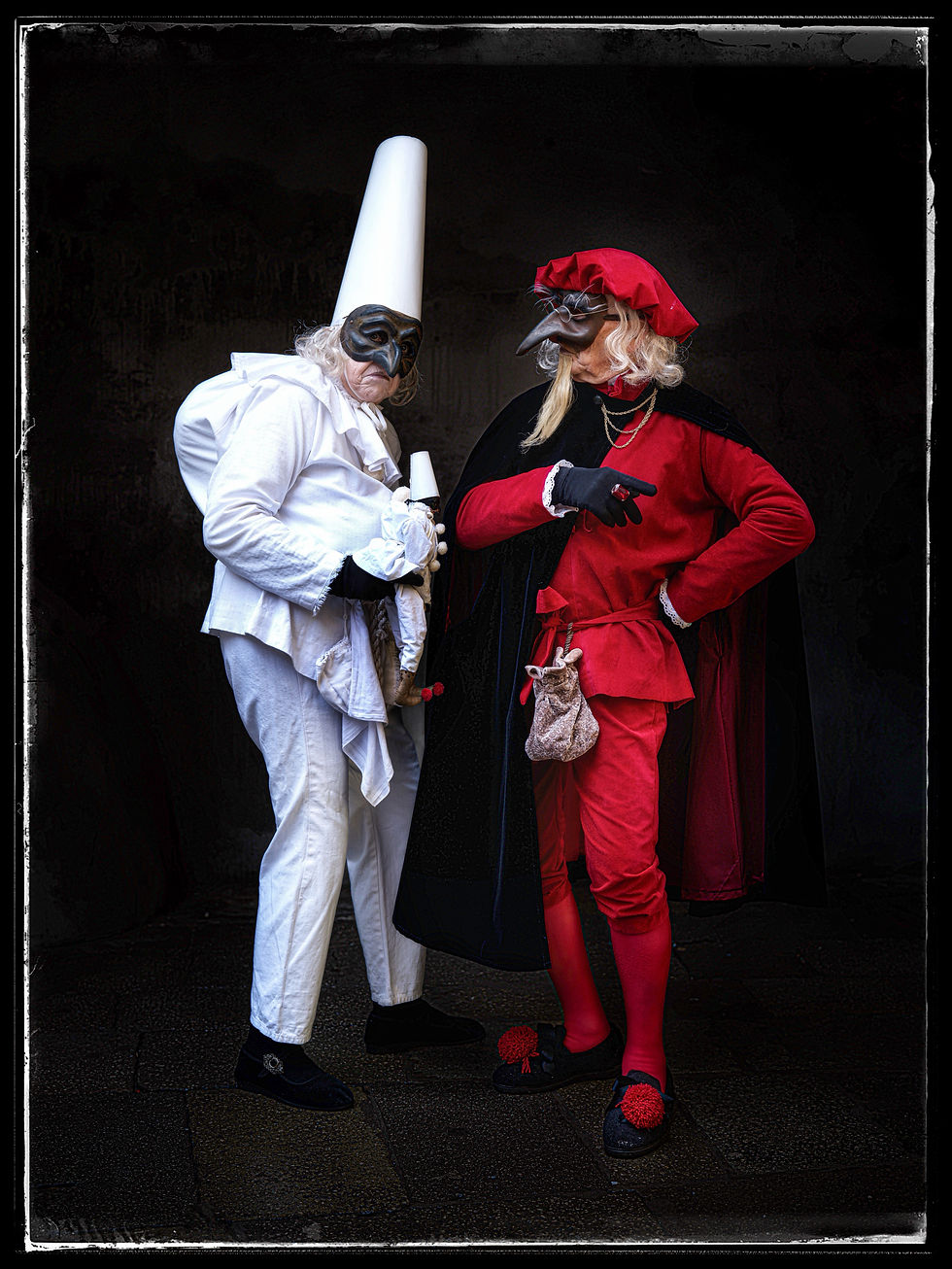
The Venice Carnevale is not solely about masks. Local Italians and an increasing number of foreign costumers now prefer historical costumes or painted faces. During Carnevale, the whole Venice becomes a real life theatrical stage...
Rudolf and Elisabeth Stelzig return this year in their forever classic costumes of Pulcinello and Pantelone. The original photos were done against a grey wall on the busy streets of Venice during Carnevale and using only natural lighting. The painted garden background was subsequently added on post processing.


Comments