


Moschettiere 火槍手 銃士
- Robin Yong

- 4 days ago
- 3 min read

In the year 1648, when the canals of Venice glimmered like black mirrors beneath torchlight, a stranger arrived from the north. He came aboard a merchant vessel from Amsterdam, carrying no luggage save a polished musket, a velvet satchel, and a silence that seemed older than the sea.
His name was Hendrik van der Meer, though in Venice they soon called him Il Moschettiere Olandese—the Dutch Musketeer.

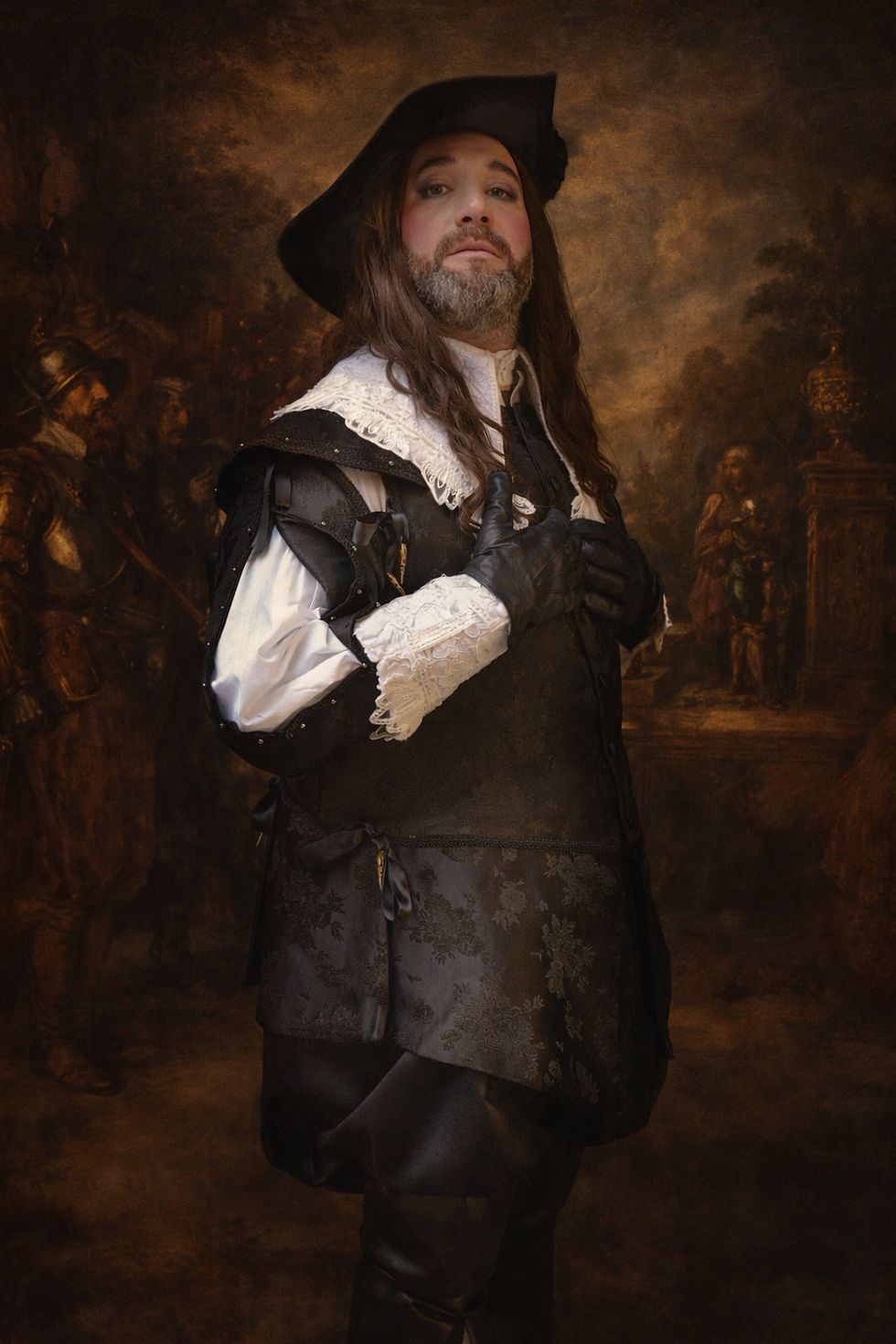
He was a man of stern bearing, dressed in black silk embroidered with shadowed flowers, his white collar sharp as frost, and gloves of dark leather that never left his hands. His beard was touched with silver, and his eyes carried the heavy light seen in the portraits of Rembrandt himself—eyes that had known both fortune and grief.
No one knew why Hendrik had come to Venice.
Some said he was a soldier who had fought in the wars of Europe and sought peace among painters and poets. Others whispered he was an assassin hired by noble families to settle matters too delicate for courts. The gondoliers, who trusted no nobleman and feared no ghost, claimed he was chasing a woman whose portrait he carried hidden in his satchel.
Each evening he could be found at twilight in San Marco, standing beneath the bells, watching the pigeons rise like ash into the fading sky.
Venice in those days was a city of masks, bargains, and secrets. Gold changed hands more quickly than prayers, and behind every velvet curtain waited another scheme. It was not long before Hendrik’s reputation reached the ears of Contessa Valeria Morosini, a widow whose palace overlooked the Grand Canal and whose beauty was rivaled only by the number of men ruined by it.
She summoned him.
In her candlelit chamber hung paintings from Titian, Tintoretto, and one unfinished portrait unlike the others—a Dutch-style canvas of a young woman holding a tulip.
Hendrik froze when he saw it.
“She was my daughter,” said the Contessa softly. “Taken from me years ago and sent north for safety during plague season. She vanished in Amsterdam. I was told she died.”
Hendrik removed from his satchel a small miniature portrait—the same young woman, older now, smiling faintly.
“She did not die,” he said. “She became my wife.”
The room fell still.
He told the tale: how he had found her working in a flower market beside the canals of Holland, how she spoke of Venice with tears in her eyes, how she had longed to return but died before the journey could be made. Her last wish had been simple:
Bring me home.
So Hendrik had come across Europe with her ashes sealed in silver.
The Contessa wept without sound.
But grief in Venice was never allowed to remain pure for long. Her brother, greedy for inheritance, burst into the chamber with armed men, seeking to seize the ashes and deny the bloodline forever.
What followed became legend.

Hendrik moved like a shadow sprung to life. His musket thundered once, shattering a chandelier into sparks. Then with sword drawn from beneath his coat, he fought across marble floors and silk draperies, driving back three men at once. He was not young, but every motion was practiced like brushstrokes on a master’s canvas.
When the guards finally arrived, the brother had fled bleeding into the canals.
At dawn, mother and son-in-law stood together upon a quiet gondola. Beneath a pale Venetian sky, they scattered the ashes into the lagoon.
The water carried them into light.

Hendrik remained in Venice many years after. He became a figure seen at dusk on bridges and in galleries, advising painters on shadows and soldiers on aim. Some evenings he stood motionless in black attire, hand upon his chest, gazing upward as though listening for distant bells.
And if asked what brought him there, he would only answer:
“Love travels farther than war.”
A Dutch musketeer was a 17th-century infantryman armed with a muzzle-loading musket, critical to Dutch armies during the Eighty Years' War and later conflicts. These soldiers were highly trained in complex drilling procedures, often depicted in historical engravings from the early 1600s.
While the word "musketeer" usually brings to mind the famous French guard, the Dutch musketeer played a foundational role in the evolution of modern military tactics. During the Dutch Golden Age, the Dutch Republic's army became a model for all of Europe.
The Venice Carnevale is not solely about masks. Local Italians and an increasing number of foreign costumers now prefer historical costumes or painted faces. During Carnevale, the whole Venice becomes a real life theatrical stage...Moschettiere is the costume from Gaetano Datar at this year's Venice Carnevale.


Comments