


L’ultima lacrima 最後一滴眼淚


L’ultima lacrima, performed by @hansgianni .
It tells about the gift to convert all pain into a tear. And if it leaves, the handkerchief will catch it. As it falls, all the pain will be gone…
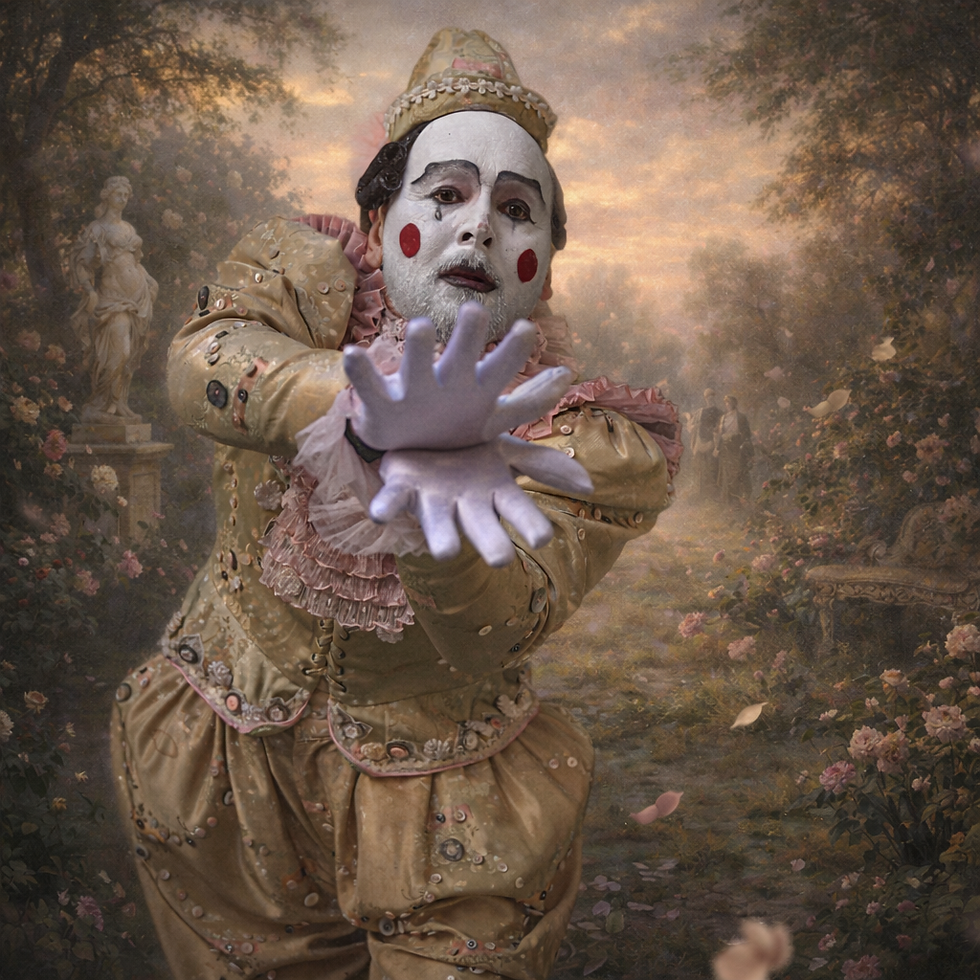


In a secluded Italian garden, where marble statues watched in silence and autumn leaves whispered secrets to the earth, there sat a clown dressed in fading gold.
They once called him Il Custode delle Lacrime—The Keeper of Tears.
Now, he performed for no one.
Seated upon a worn stone pedestal, he pressed a lace handkerchief gently to his painted face, as though waiting… not for applause, but for something far more fragile.
A tear.
His act had made him a legend across Italy.
From Venice to Florence, from crowded piazzas to candlelit theatres, people came not to laugh—but to be relieved.
He would sit just as he did now—quiet, still, listening.
Each person would approach and offer their pain.
Not loudly.
Not dramatically.
Just a whisper.

A lost love.
A betrayed trust.
A grief too heavy to name.
And the clown would accept it all.
No words.
No judgment.
Only stillness.

Then, slowly, impossibly—
His painted eyes would tremble.
And from them would fall a single tear.
Only one.
But within that tear lived everything the person had given him—their sorrow, their regret, their wounds.
Before it could reach the ground, he would raise his handkerchief.
Soft lace.
Always the same one.
The tear would fall into it.
And the moment it did—
The pain would vanish.
Not fade.
Not lessen.
Disappear.
As though it had never been.
The person would stand, confused at first… then lighter, freer, as if chains had quietly slipped from their soul.
And the clown would bow.
That was his act.
That was his gift.

But gifts, as Pulcinello often said, are never free.
Pulcinello had followed him for years.
Always watching.
Always laughing.
With his crooked mask, sharp nose, and restless energy, Pulcinello belonged to chaos—the very opposite of the silent, solemn clown.
He would lean against columns during performances, whispering to himself.
“Another tear,” he would chuckle. “Another piece of himself gone.”
The clown never responded.
One evening, in that very garden where he now sat alone, Pulcinello appeared again.
The air was thick with dusk, and the statues seemed almost alive in the dimming light.
“You’ve grown quiet,” Pulcinello said, stepping closer. “No crowds. No tears. No miracles.”
The clown lowered the handkerchief slightly.
“There is no one left who believes.”
Pulcinello tilted his head.
“Oh, they believe. They just fear the cost.”
The clown said nothing.
But Pulcinello saw it.
The exhaustion.
The emptiness.
“Tell me,” Pulcinello said, circling him slowly, “when you take their pain… where does it go?”

The clown closed his eyes.
“It becomes a tear.”
“And then?”
“It falls.”
“And then?”
The clown hesitated.
Pulcinello leaned in, his voice almost a whisper.
“And then it becomes you.”
Silence.
The garden held its breath.


Pulcinello straightened and laughed softly.
“You thought it vanished, didn’t you? No, no… nothing so convenient. Pain changes form. It always does.”
The clown’s grip tightened around the handkerchief.
“But I take it from them.”
“Yes,” Pulcinello nodded. “And you keep it.”

That night, as if summoned by fate itself, a final visitor entered the garden.
An old man.
Bent with grief.
His steps were slow, but his eyes burned with something unbearable.
“I was told…” he began, voice trembling, “you can take it away.”
The clown looked at him.
And for a moment—just a moment—he considered refusing.
Pulcinello watched from the shadows, silent now.
Waiting.
“What is your pain?” the clown asked.
The old man’s voice broke.
“My son.”
Nothing more.
Nothing needed.
The clown inhaled slowly.
This pain… it was vast.
Too vast.
He felt it already pressing against him, before even taking it in.
Pulcinello stepped forward.
“Careful,” he said softly. “This one might be your last.”
The clown did not look at him.
He simply nodded.
The old man spoke.
And as he did, the garden seemed to darken, as though even the statues could not bear witness.
When he finished, he fell silent.
Broken.
Waiting.
The clown closed his eyes.
And began his act.
The tear formed slowly.
Heavier than any before.
It trembled on the edge of his painted eye, shimmering with a weight no cloth should carry.
Pulcinello did not move.
He did not laugh.
For once, he only watched.
The clown raised the handkerchief.
The tear fell.
It touched the lace.
The world shifted.
The old man gasped.
His body loosened, as though something invisible had been lifted from him.
His grief—gone.
Just like that.
He looked at his hands, then at the clown, tears of confusion—not pain—falling freely.
“Grazie,” he whispered.
And he left.
The garden returned to silence.
But the clown remained frozen.
Still holding the handkerchief.
Something was wrong.
He waited.
For another tear.
For the familiar weight.
For the quiet ache that always followed.
But—
Nothing came.

Pulcinello stepped closer.
“Well?” he asked.
The clown slowly lowered the handkerchief.
Empty.
Dry.
“I cannot…” the clown whispered. “I cannot feel it.”
Pulcinello nodded, almost gently.
“Of course you can’t.”
He gestured to the cloth.
“That was the last one.”
The clown looked up.
For the first time, there was something unfamiliar in his eyes.
Not sorrow.
Not peace.
Something hollow.
“My gift…” he said.
Pulcinello smiled, but it was softer now.
“Your gift was never endless.”
He leaned closer.
“You gave until there was nothing left to give.”
The wind moved through the trees.
Leaves fell like quiet applause.
The clown sat still on the stone pedestal, his handkerchief resting lifeless in his hand.
No more tears would come.
No more pain could be taken.
No more miracles would happen.
Pulcinello turned to leave.
But before he disappeared into the fading light, he paused.
“And now,” he said, without looking back,
“you must learn what it means to live without sorrow… or purpose.”

The garden darkened.
The statues watched.
And the clown—once the keeper of all pain—sat in perfect stillness,
holding a handkerchief that would never again catch
The Last Tear.

L'ultima lacrima is a powerful street performance by veteran Venice Carnevale costumer Gianni Hans. The original portraits were done against a grey wall and using only natural lighting. A second version of the pictures was subsequently done using AI to paint the background of an Italian garden. The Venice Carnevale is not all about masks. Many local Italians prefer painted faces and historical costumes. And for a small number of Venice Carnevale celebrities, it's more about street theatre.


Comments