


Anubis and Bastet 阿努比斯與芭絲特 アヌビスとバステト
- Robin Yong

- Mar 20
- 7 min read

"L'uomo teme il tempo, ma il tempo teme le piramidi"
"Man fears time, but time fears the pyramids"....
In the age when the Nile still whispered secrets to the stars, and the desert remembered every footstep, there walked two eternal watchers: Anubis, the jackal-headed guardian of the dead, and Bastet, the radiant cat of life, grace, and hidden fire.

The Watchers of the Threshold
They met not in temples, nor in the courts of gods—but between moments.
At twilight.
At that fragile hour when shadows grow long and the living begin to resemble the dead.
Anubis stood at the edge of the necropolis, where the pyramids pierced the horizon like the teeth of eternity. His golden eyes did not blink. He had weighed the hearts of kings and beggars alike, and none had surprised him.
Bastet approached without sound.
She never needed to announce herself.
“You stand too still, old jackal,” she said, her voice soft as silk drawn across stone. “Even time moves.”
Anubis turned his gaze toward the pyramids.
“No,” he replied. “Time moves for men.”
The Pyramids and the Fear of Time
Bastet followed his gaze. Above them, the Milky Way stretched like a celestial river—older than memory, yet ever-changing.
“Men fear time,” she mused. “It devours their youth, their beauty, their names.”
Anubis nodded.
“And yet…”
He gestured to the pyramids—silent, immense, defiant.
“…time fears these.”
Bastet smiled faintly. “Stone fears nothing. It merely endures.”
“Endurance,” Anubis said, “is what even time cannot conquer.”

A Question of Eternity
They walked together across the sand, their forms half-shadow, half-divinity.
“Tell me,” Bastet said, “you who guide souls—what do they fear most when they come to you?”
Anubis did not hesitate.
“Not death,” he said. “They fear being forgotten.”
Bastet’s eyes softened.
“And yet the pyramids remember.”
“Yes,” Anubis replied. “But not the way men hope. Names erode. Faces vanish. Even kings become dust.”
“Then why do they build such monuments?” she asked.
Anubis paused.
“To challenge time,” he said. “To say: I was here.”
The Secret They Both Knew
Bastet circled him slowly, her presence warm, alive, defiant.
“And do they win?”
Anubis looked once more at the pyramids, their edges softened by centuries, yet still unbroken.
“For a while.”
Bastet laughed—soft, but not unkind.
“Then the quote is wrong,” she said.
“Man fears time, but time does not fear pyramids.”
Anubis tilted his head.
“No,” he said quietly.
“It does.”
She raised an eyebrow.
“Because even time,” he continued, “cannot erase the idea of them.”
Bastet fell silent.
The wind moved through the desert like a breath from another age.
“The pyramids are not stone,” Anubis said.
“They are defiance made visible.”
The Balance of All Things
At last, Bastet sat upon the sand, gazing upward.
“And where do we stand in all this?” she asked. “You, who guard endings. Me, who guard beginnings.”
Anubis stood beside her.
“We stand where time cannot.”
She glanced at him.
“Between?”
“Yes.”
Between heartbeat and silence.
Between memory and oblivion.
Between man… and the eternal.


The Final Truth
The stars turned slowly above them.
The pyramids endured.
And somewhere, far below the sand, the bones of kings whispered stories no living tongue could speak.
Bastet closed her eyes.
“Perhaps,” she said, “it is not that time fears pyramids.”
Anubis waited.
“It is that pyramids remind time… that even it is not infinite in meaning.”
Anubis did not answer.
He did not need to.
For in that moment, beneath the endless sky, both gods understood:
Time devours all things—
but what is remembered, resisted, and reimagined…
becomes something time itself must bow to.

Anubis and Bastet are two prominent Egyptian deities, often paired in modern Neo-Wiccan or Kemetic practices for their fame, though they lacked significant ancient historical partnership. Anubis, the jackal-headed god, guards the dead and embalming while Bastet, the cat-headed goddess, protects homes and fertility.
Anubis is the god of funerary rites, protector of graves, and guide to the underworld in ancient Egyptian religion, usually depicted as a canine or a man with a canine head.
Like many ancient Egyptian deities, Anubis assumed different roles in various contexts. Depicted as a protector of graves as early as the First Dynasty (c. 3100 – c. 2890 BC), Anubis was also an embalmer. By the Middle Kingdom (c. 2055–1650 BC) he was replaced by Osiris in his role as lord of the underworld. One of his prominent roles was as a god who ushered souls into the afterlife. He attended the weighing scale during the "Weighing of the Heart", in which it was determined whether a soul would be allowed to enter the realm of the dead. Anubis is one of the most frequently depicted and mentioned gods in the Egyptian pantheon.Anubis was depicted in black, a color that symbolized regeneration, life, the soil of the Nile River, and the discoloration of the corpse after embalming. Anubis is associated with Wepwawet, another Egyptian god portrayed with a dog's head or in canine form, but with grey or white fur. Historians assume that the two figures were eventually combined.
As jmy-wt (Imiut or the Imiut fetish) "He who is in the place of embalming", Anubis was associated with mummification. He was also called ḫnty zḥ-nṯr "He who presides over the god's booth", in which "booth" could refer either to the place where embalming was carried out or the pharaoh's burial chamber.
In the Osiris myth, Anubis helped Isis to embalm Osiris. Indeed, when the Osiris myth emerged, it was said that after Osiris had been killed by Set, Osiris's organs were given to Anubis as a gift. With this connection, Anubis became the patron god of embalmers; during the rites of mummification, illustrations from the Book of the Dead often show a wolf-mask-wearing priest supporting the upright mummy.
Anubis was a protector of graves and cemeteries. Several epithets attached to his name in Egyptian texts and inscriptions referred to that role. Khenty-Amentiu, which means "foremost of the westerners" and was also the name of a different canine funerary god, alluded to his protecting function because the dead were usually buried on the west bank of the Nile. He took other names in connection with his funerary role, such as tpy-ḏw.f (Tepy-djuef) "He who is upon his mountain" (i.e. keeping guard over tombs from above) and nb-t3-ḏsr (Neb-ta-djeser) "Lord of the sacred land", which designates him as a god of the desert necropolis.
The Jumilhac papyrus recounts another tale where Anubis protected the body of Osiris from Set. Set attempted to attack the body of Osiris by transforming himself into a leopard. Anubis stopped and subdued Set, however, and he branded Set's skin with a hot iron rod. Anubis then flayed Set and wore his skin as a warning against evil-doers who would desecrate the tombs of the dead. Priests who attended to the dead wore leopard skin in order to commemorate Anubis's victory over Set. The legend of Anubis branding the hide of Set in leopard form was used to explain how the leopard got its spots.
Most ancient tombs had prayers to Anubis carved on them.
By the late pharaonic era (664–332 BC), Anubis was often depicted as guiding individuals across the threshold from the world of the living to the afterlife. Though a similar role was sometimes performed by the cow-headed Hathor, Anubis was more commonly chosen to fulfill that function. Greek writers from the Roman period of Egyptian history designated that role as that of "psychopomp", a Greek term meaning "guide of souls" that they used to refer to their own god Hermes, who also played that role in Greek religion. Funerary art from that period represents Anubis guiding either men or women dressed in Greek clothes into the presence of Osiris, who by then had long replaced Anubis as ruler of the underworld.
One of the roles of Anubis was as the "Guardian of the Scales." The critical scene depicting the weighing of the heart, in the Book of the Dead, shows Anubis performing a measurement that determined whether the person was worthy of entering the realm of the dead (the underworld, known as Duat). By weighing the heart of a deceased person against ma'at, who was often represented as an ostrich feather, Anubis dictated the fate of souls. Souls heavier than a feather would be devoured by Ammit, and souls lighter than a feather would ascend to a heavenly existence.
Anubis was one of the most frequently represented deities in ancient Egyptian art. He is depicted in royal tombs as early as the First Dynasty. The god is typically treating a king's corpse, providing sovereign to mummification rituals and funerals, or standing with fellow gods at the Weighing of the Heart of the Soul in the Hall of Two Truths. One of his most popular representations is of him, with the body of a man and the head of a jackal with pointed ears, standing or kneeling, holding a gold scale while a heart of the soul is being weighed against Ma'at's white truth feather.


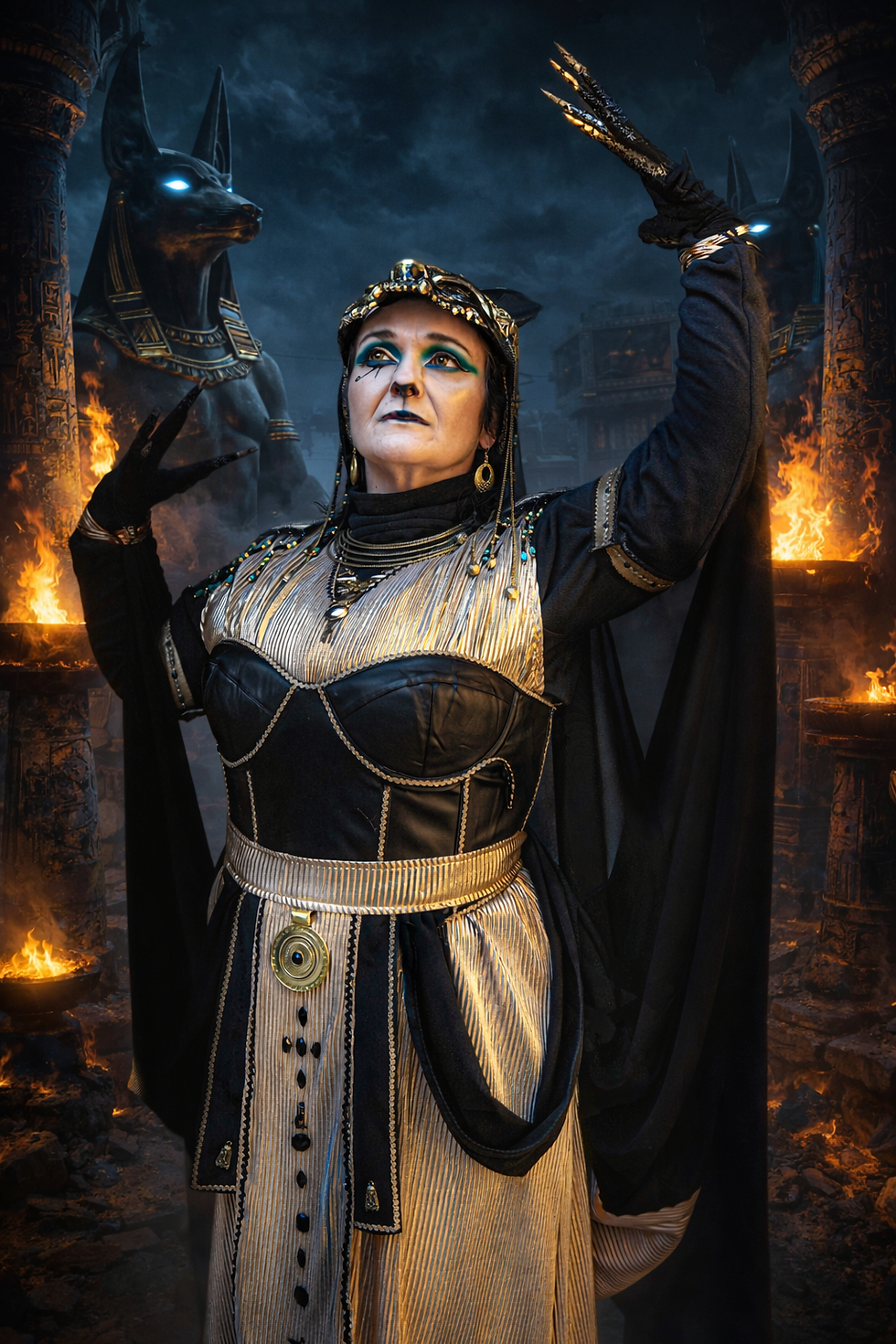
Bastet was worshipped in Bubastis in Lower Egypt, originally as a lioness goddess, a role shared by other deities such as Sekhmet. Eventually Bastet and Sekhmet were characterized as two aspects of the same goddess, with Sekhmet representing the powerful warrior and protector aspect, and Bastet, who increasingly was depicted as a cat, representing a gentler aspect.
As protector of Lower Egypt, she was seen as defender of the king, and consequently of the sun god, Ra. Along with other deities such as Hathor, Sekhmet, and Isis, Bastet was associated with the Eye of Ra. She has been depicted as fighting the evil snake named Apep, an enemy of Ra. In addition to her solar connections, she was also related to Wadjet, one of the oldest Egyptian goddesses from the Southern Delta who was dubbed "eye of the moon".
Bastet was also a goddess of pregnancy and childbirth, possibly because of the fertility of the domestic cat. Images of Bastet were often created from alabaster. The goddess was sometimes depicted holding a ceremonial sistrum in one hand and an aegis in the other—the aegis usually resembling a collar or gorget, embellished with a lioness head.
Bastet was also depicted as the goddess of protection against contagious diseases and evil spirits.
Cats in ancient Egypt were highly revered, partly due to their ability to combat vermin such as mice and rats which threatened key food supplies, as well as snakes—especially cobras. Cats of royalty were, in some instances, known to be dressed in golden jewelry and allowed to eat from the same plate as other members of the household. Dennis C. Turner and Patrick Bateson estimate that during the Twenty-second Dynasty (c. 945–715 BCE), Bastet changed from being a lioness deity into being predominantly a major cat deity.


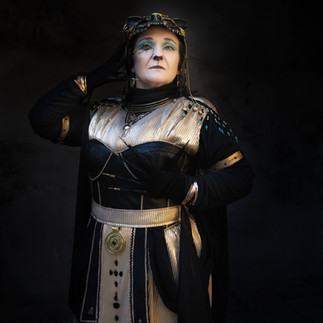


Anubis and Bastet are the costumes of Italian husband and wife team Rivera and Tellarini.
The Venice Carnevale is not all about masks. Many local Italians prefer painted faces, historical costumes and recently even cosplay. The original portraits were done on the busy streets of Venice during Carnevale, against a dark grey wall. The background was subsequently changed to match the storyline.


Comments