


Peking Opera: Legend of the White Snake 京劇: 白蛇傳
- Robin Yong

- Feb 2
- 10 min read

The item, "Peking opera" was inscribed on UNESCO's Representative List of the Intangible Cultural Heritage of Humanity in 2010.
Peking opera is a performance art incorporating singing, reciting, acting, martial arts.
Although widely practised throughout China, its performance centres on Beijing, Tianjin and Shanghai.
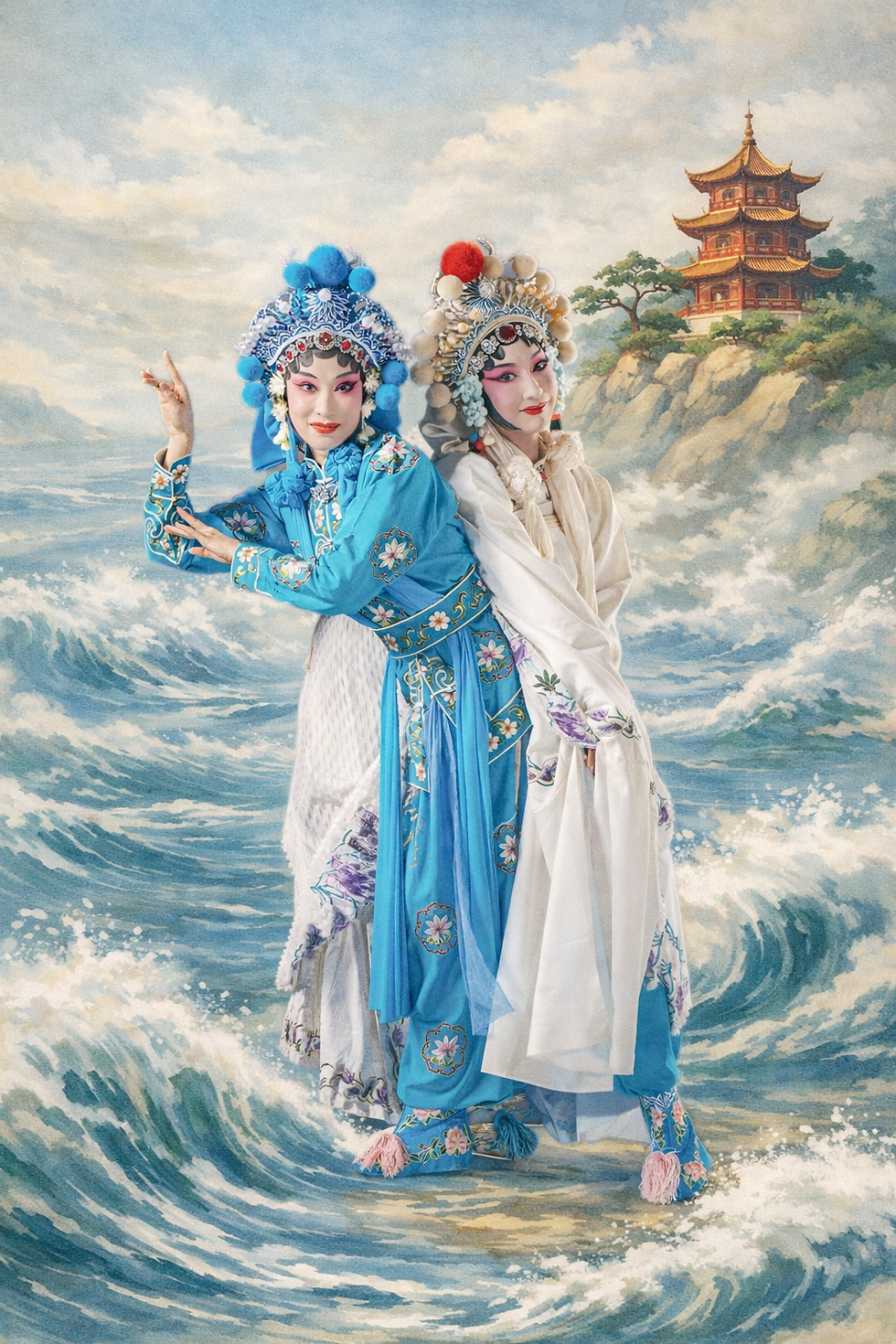
These ones are modern/ current era costumes of Peking Opera. From my recent trip to Shanghai.
The ladies are well-known Chinese actresses.
The makeup artiste and costumer is also a well-known opera actor very active in the fashion world and has appeared in GQ fashion magazines.
Photo Concept is to mimic those old China posters and calendars from the early 1980s…
Starring 奥黛麗佳 as Madam White Snake,
Makeup and costumes by 方林飛.
The Legend of the White Snake is a Chinese legend centered around a romance between a man named Xu Xian and a female snake spirit named Bai Suzhen. It is counted as one of China's Four Great Folktales, the others being Lady Meng Jiang, Butterfly Lovers, and The Cowherd and the Weaver Girl (or occasionally The Tale of Liu Yi or The Marriage of the Fairy Princess). The story has evolved and changed over different eras and regions to suit the preferences of the populace and rulers, serving as subject matter for novels, operas, and other media
The legend gained significant attention in post-war Japan. In 1956, on the orders of Zhou Enlai, a Peking opera troupe led by Mei Lanfang visited Japan and performed pieces from The Legend of the White Snake. That same year, Japan's first color special effects film, The Legend of the White Serpent, was released. In 1958, Japan's first color feature-length animated film, The Tale of the White Serpent, was released, making the story familiar to the general Japanese public.

The Tang dynasty story collection Boyi zhi (博異志; "Vast Records of the Strange"), by Gu Shenzi (Zheng Huangu, mid-Tang era), contains a chuanqi tale titled "Li Huang" (李黃). This is considered the oldest surviving story related to the Legend of the White Snake. It was later included in the Taiping Guangji.
In the second year of the Yuanhe era (807), Li Huang, the nephew of the Salt and Iron Commissioner Li Xun, met a beautiful woman in white riding an ox cart in the East Market of Chang'an. When he asked her maidservant, he was told that she was a widow whose mourning period for her husband had just ended and that she had no money. Li Huang advanced her money and silk, and was invited to her residence. An old woman claiming to be the white-clad lady's aunt (clothed in blue-green) appeared, claiming they were poor and owed 30,000 cash, and offered to let the lady serve him. Li Huang sent a servant to fetch 30,000 cash and stayed there for three days at their invitation. On the fourth day, the old woman urged him to return home temporarily so his uncle would not blame him for staying out so long. The servant noticed that Li Huang smelled raw and fishy but returned home as ordered. When asked by his family what he had been doing for days, he fell ill and immediately went to bed. Eventually, he began to rave incoherently and told his fiancée that he was done for. When the bedding was fearfully lifted, his body had dissolved into water, leaving only his head. The family questioned the servant and went to the woman's house, but found only a desolate garden. There was a single Chinese honey locust tree; atop the tree was 15,000 cash, and beneath it another 15,000. Neighbors said that other than a large white snake often seen coiled under the tree, there was nothing there.
A different version appended in the Taiping Guangji is named as "Another Version," where the plot is largely the same but with slight differences. The protagonist's name is Li Guan, and instead of his body turning to water, his head splits open and he dies. When the family went to the location of the woman's house, they found a withered pagoda tree, with traces of a large snake coiling. Digging up the roots, they found several small white snakes, which they killed before returning home.

Around the Jiajing era of the Ming dynasty (1541–1551), a story considered to be the formation of the "White Snake Legend" appeared: "The Three Pagodas of West Lake" (西湖三塔記) in the Qingpingshantang Huaben compiled by Hong Pian (洪楩). This was a written record of a storyteller's script and is considered the oldest existing huaben. Aoki Masaru in "The Novel 'West Lake Three Pagodas' and 'Thunder Peak Pagoda'" suggests that a story involving the three pagodas standing in West Lake seems to be the prototype. However, in this huaben, the "Thunder Peak Pagoda" (Leifeng Pagoda) does not yet appear; instead, it features "three stone pagodas.
In the Chunxi era (1174–1189) of Emperor Xiaozong of Song, Xi Xuanzan (奚宣贊), the only son of a commander named Xi serving under Yue Fei and living inside the Yongjin Gate of Lin'an Prefecture, went sightseeing at West Lake during the Qingming Festival. There, he found a lost girl dressed entirely in white silk. When asked, she said her name was Bai (White), she lived at West Lake, and had become separated from her grandmother. Since the girl grabbed Xuanzan's clothes and wouldn't let go, he took her home. Her name was Maonu. After more than ten days, an old woman dressed in black arrived in a sedan chair, claiming to be the grandmother. She invited Xuanzan to her home to thank him. Upon arriving at a mansion, a lady in white (the mother) appeared. Hearing that Xuanzan had saved her daughter, she treated him to a feast of delicacies. A servant then suggested killing a "former one" since a "new one" had arrived. The lady agreed to use him as a side dish for Xuanzan. Two strong men dragged out a young man, tied him to a pillar, cut open his belly, and presented his heart and liver to the lady. Xuanzan was too terrified to drink. After the lady and the old woman finished eating the organs, the lady seduced Xuanzan, asking him to marry her since she was a widow. They stayed together for over half a month. Xuanzan, looking yellow and emaciated, asked to go home temporarily. A servant then appeared suggesting the lady dispose of the "former one" (Xuanzan) as a "new one" had arrived. Just as his heart was about to be taken, Maonu begged for his life since he had saved her. Maonu told Xuanzan to keep his eyes closed, carried him on her back, and flew away. Xuanzan felt her neck and realized she had feathers. When he opened his eyes upon landing, he was on the city wall. A year later, during the Qingming Festival, Xuanzan was hunting birds with a crossbow. He shot a crow, which fell and turned into the old woman in black. He was captured and again forced to be the husband of the lady in white for half a month. Again faced with death, Maonu saved him. Later, Xuanzan's uncle, the Daoist Xi Zhenren from Mount Longhu, arrived. Seeing a black aura, he realized his nephew was possessed by demons. He summoned divine generals at the Four Sages Shrine by West Lake to capture the three demons. They appeared as a black chicken (Maonu), an otter (the old woman), and a white snake (the lady in white). The Zhenren trapped them in an iron cage, sank them into West Lake, and built three stone pagodas to suppress them. Xuanzan became a lay disciple of his uncle and lived out his life.

Around the Wanli era of the Ming Dynasty (1573–1620), the story "The Double Fish Fan Pendant" (Shuangyu Shanzhui; also known as Kong Shufang Shuangyu Shanzhui Zhuan) appeared, seemingly based on Southern Song storytelling scripts. In this version, the seductress is a ghost rather than a white snake, but the plot of a young merchant being seduced and nearly killed, then saved by a Zhenren (Daoist spiritual master), parallels "The Three Pagodas of West Lake". Similarities have also been pointed out with "The Peony Lantern" (Mudan Deng Ji) from the Jiandeng Xinhua (c. 1378).
Synopsis of "Double Fish Fan Pendant": In the Hongzhi era (1488–1505), Xu Jingchun, a 26-year-old merchant, met a beautiful woman named Kong Shufang and her maid Yumei. She claimed to be the daughter of a local official. Jingchun was seduced and spent the night with her. Neighbors found him passed out in a graveyard. Although cured by rituals, he later encountered Kong Shufang again upon returning from a business trip. She gave him a fan pendant shaped like two fish. He fell under her spell again, and his health deteriorated. His father sought help from a Daoist master at Ziyang Palace. The master summoned gods to arrest the spirits. Under torture, Kong Shufang confessed she was a ghost seeking love. The master sent the two spirits to the King of Hell for punishment, and Jingchun recovered.
The story "Madam White Is Kept Forever Under the Thunder Peak Tower" (白娘子永鎭雷峰塔) in Feng Menglong's influential 1624 collection Stories to Caution the World (Jingshi Tongyan, Vol. 28) became the pivot point for the development of the White Snake legend.While "The Three Pagodas" had two purposes for the demon (lust and eating liver), this version replaces the eating of liver with theft. The setting also shifts from Hangzhou/West Lake to Suzhou and Zhenjiang before returning to West Lake. This story began to portray the White Snake in a more sympathetic perspective. This story is considered the basis for the Japanese story "The Lust of the White Serpent" in Ueda Akinari's Ugetsu Monogatari.
During the Shaoxing era of the Southern Song, Xu Xuan (許宣; formerly Xi Xuanzan) is a young man working in a herbal medicine shop in Lin'an. On the Qingming Festival, he meets a beautiful woman in white (Bai Niangzi/Lady White) and her maid in blue-green named Qingqing, (青青), a fish spirit) on a boat in the rain. He lends them an umbrella. Bai Niangzi claims to be a widow. They become intimate, and she gives him 50 taels of silver to arrange their marriage. However, the silver turns out to be stolen from the government treasury. Xu Xuan is arrested, tortured, and exiled to Suzhou for the crime. In Suzhou, Xu Xuan meets Bai Niangzi again. She claims the money was from her late husband and she didn't know it was stolen. They marry. Later, Xu Xuan meets a Daoist who warns him of a demon. He tries to burn a talisman to reveal her form, but she talks her way out of it. Later, Xu Xuan is accused of theft again regarding jewelry Bai Niangzi gave him, and is exiled to Zhenjiang. In Zhenjiang, Xu Xuan works in a medicine shop. He reunites with Bai Niangzi again, who claims the items were inherited. They live together, but a lecherous birthday host spies on her in the bathroom and sees a giant white snake, frightening him to death. Xu Xuan visits Jinshan Temple and meets the Zen master Fahai. Fahai recognizes the demon. When Bai Niangzi arrives to take Xu Xuan back, she creates a storm/flood (though less catastrophic than in later versions). Fahai drives them away. Xu Xuan returns to Hangzhou upon an amnesty. He tries to leave Bai Niangzi, but she threatens to drown the city. Xu Xuan seeks Fahai's help. Fahai gives him an alms bowl to trap her. Xu Xuan places the bowl over her head, shrinking her. Fahai reveals Bai Niangzi is a white snake and Qingqing is a blue fish. He imprisons them under the Leifeng Pagoda. Xu Xuan becomes a monk and eventually dies sitting in meditation.

The Qing dynasty saw major transformations of the legend thanks to Chinese opera and quyi (storytelling performances).
A modified version of Feng Menglong's story, titled "The Strange Traces of Thunder Peak" (Leifeng Guaiji), was included in the collection Xihu Jiahua (Fine Tales of the West Lake) during the Kangxi era.
Major shifts occurred in texts from the late eighteenth and early nineteenth century, where the White Snake became endearing and devoted, while Fahai's portrayal became more negative.
Huang Tubi (黃圖珌)'s 1738 chuanqi play Leifeng Pagoda is considered similar to Feng Menglong's version. However, Fang Chengpei (方成培)'s 1771 Leifeng Pagoda (performed for the Qianlong Emperor) introduced key elements like the "Stealing the Immortal Herb" and the existence of a son born to Bai and Xu.
In the 20th century, modern playwright Tian Han revised the story three times (1943, 1952, 1955) for the Peking Opera. His versions changed Bai Suzhen from a widow to an unmarried young woman and solidified the current popular version of the story.
In current modern day Peking Opera, A white snake and a blue-green snake from Mount Emei transform themselves into two young women called Bai Suzhen and Xiaoqing, respectively. They become best friends and travel to Lin'an Prefecture (or Hangzhou), where they meet a young man named Xu Xian on a ferry-boat in West Lake. Xu Xian lends them his umbrella because it is raining. Xu Xian and Bai Suzhen fall in love instantly and are eventually married. They open a medicine shop.
Fahai, the abbot of Jinshan Temple in Zhenjiang, approaches Xu Xian and tells him that his wife is a snake. Xu Xian brushes him off, so Fahai tells him that he should have her drink realgar wine during the Dragon Boat Festival. Bai Suzhen unsuspectingly drinks the wine and reveals her true form as a large white snake. Xu Xian dies of shock after seeing that his wife is not human.
Bai Suzhen travels to Kunlun, where she braves danger to steal a magical herb (Ganoderma) guarded by disciples of the Old Man of the South Pole. The herb restores Xu Xian to life.
After coming back to life, Xu Xian is still fearful of his wife. He travels alone to Jinshan Temple, where Fahai imprisons him, telling him that he must live in the temple in order to save himself from the snake demons. Bai Suzhen and Xiaoqing fight with Fahai to rescue Xu Xian. During the battle, Fahai calls on guardian deities like Weituo and Qielan to help him. Bai Suzhen uses her powers to flood the temple, causing collateral damage in the process. However, her powers are limited because she is already pregnant with Xu Xian's child, so she fails to save her husband. Xiaoqing helps her escape back to Hangzhou.
Meanwhile, Xu Xian realizes that his wife's love for him is genuine and that he no longer cares if she is a snake. He manages to escape after persuading a sympathetic young monk to release him. When he reunites with his battered wife on Broken Bridge, where they first met, Xiaoqing is so furious at him that she intends to kill him, but Bai Suzhen stops her. Xu Xian expresses his regret, and both Bai Suzhen and Xiaoqing forgive him, Xiaoqing more reluctantly.
Bai Suzhen gives birth to their son, Xu Mengjiao (in some versions Xu Shilin). Fahai tracks them down, defeats Bai Suzhen and imprisons her under Leifeng Pagoda, despite pleadings from Xu Xian. Xiaoqing flees, vowing vengeance.
In some versions, Xiaoqing later returns after mastering fire magic to defeat Fahai and destroy the pagoda, or Bai Suzhen's son grows up to earn the title of top scholar (Zhuangyuan) and pays respects at the pagoda, moving the heavens to release his mother.


Elegant presentation of the Peking Opera performance and its rich cultural heritage. The descriptions reflected both artistic beauty and deep respect for tradition, making the story enjoyable even for readers unfamiliar with the subject. I recently read another cultural discussion involving https://www.jasonranallolaw.com/ that also highlighted the importance of preserving meaningful experiences for future generations. Content like this keeps timeless traditions alive through engaging storytelling.
https://zprotrailers.com/ After use, these trailers can be folded into compact configurations, allowing them to occupy significantly less room without sacrificing towing performance or structural integrity.
Процесът беше ясен и лесен за проследяване. внос на кола от Германия беше осъществен безпроблемно.
Designed for everyday use, offering both comfort and kostiumy kąpielowe support. Maintain shape while staying breathable.
Understanding lending criteria is essential in today’s financial world. The updated debt to income ratio requirements 2026 make it easier for applicants to evaluate their readiness and avoid unnecessary rejections from lenders.